
Addiction Help: Virtual Treatment that Meets You Where You Are
Find Addiction Help with Pathfinder Recovery’s virtual care, offering compassionate support from home to start healing, build stability, and move forward.

November 6, 2025


Written and reviewed by the leadership team at Pathfinder Recovery, including licensed medical and clinical professionals with over 30 years of experience in addiction and mental health care.
If you've started looking into virtual addiction treatment, you've probably noticed how often the word "holistic" gets used—and how rarely anyone defines it. For a working professional in Massachusetts trying to make a real healthcare decision, that vagueness is a problem.
Inside a legitimate MA virtual program, holistic doesn't mean candles and crystals. It means your care plan treats the substance use disorder, your mental health, your body, and the rest of your life as one connected system rather than separate appointments stacked on top of each other.
In practice, that usually looks like a coordinated mix of:
All of this sits inside Massachusetts' regulatory framework for SUD programs under 105 CMR 164, which licenses the clinical services—not the wellness vocabulary around them 5. So when you're vetting a program, the question isn't whether it sounds holistic. It's whether each piece is actually staffed, licensed, and clinically integrated.
Here's a quirk that trips up almost everyone comparing programs in Massachusetts: the terms "PHP" and "IOP" you see all over treatment marketing aren't actually licensed categories in this state. The Bureau of Substance Addiction Services (BSAS) doesn't license programs under those labels. So when a website promises a "Massachusetts IOP," what's really happening underneath is something else.
Under 105 CMR 164, BSAS licenses a defined set of SUD service categories. The ones most relevant to a working professional considering virtual care are Outpatient Services, Day Treatment (which is the closest equivalent to what other states call IOP), withdrawal management, and Office-Based Opioid Treatment (OBOT) for medications like buprenorphine. Partial Hospitalization Programs and Intensive Outpatient Programs, as branded terms, are not BSAS-licensed service types.6
Why does this matter to you? Because when you're vetting a program, the right question isn't "do you offer IOP?" It's "are you licensed by BSAS, and under which service category?" A legitimate virtual provider serving Massachusetts residents should be able to tell you exactly that—Outpatient Services, Day Treatment, OBOT, or some combination—and show that virtual delivery is built into how those services are authorized.5
That distinction protects you. It means the clinical staffing ratios, documentation standards, and clinical oversight tied to a licensed category apply to your care, whether the session happens in a clinic in Worcester or on your laptop at home.
If you're on Mass Health, the coverage question for virtual SUD care is more settled than you might assume. MassHealth has explicitly authorized qualified providers to deliver covered services via telehealth, and the policy language is unusually direct: it permits telehealth delivery "notwithstanding any regulation to the contrary" that would otherwise require physical presence. In plain terms, the older assumption that you had to show up in a building for a session to count is gone for covered SUD services.4
What that buys you, practically:
If you have commercial insurance instead of MassHealth, parity isn't governed by this same bulletin, but most major commercial plans in Massachusetts now cover behavioral health telehealth at rates close to in-person. The cleanest move is to ask the program directly which plans they're in-network with, and to confirm that your specific level of care (Outpatient or Day Treatment) is a covered benefit under your policy. Don't accept "we take all insurance" as an answer—ask for the network list.
If your work pulls you out of Massachusetts—client meetings in New York, a project rotation in Florida, a few weeks at a conference in Texas—there's a wrinkle worth understanding before you start treatment. Telehealth licensing generally follows the patient's location, not the clinician's. A Massachusetts-licensed clinician treating you while you're physically sitting in another state usually needs to be licensed in that state too.1
For most working professionals, this rarely becomes a hard stop. It just means a real conversation upfront with your provider about your travel patterns. A program serving multiple New England states (Massachusetts, Vermont, Connecticut, New Hampshire) can typically keep care continuous within that footprint. For occasional out-of-region travel, your clinician can help you plan around session timing or, in some cases, pause and resume. The point is to surface this at intake—not to discover it the week before a long trip.
The fair question to ask before you commit time and energy to a virtual program is whether the format actually moves the needle on the things that matter—getting started, showing up, and staying long enough for treatment to do its work. The research here is more encouraging than you might expect, and also more specific.
A peer-reviewed comparison of SUD treatment delivered during the COVID-era telehealth expansion versus pre-pandemic in-person care found that the odds of initiating SUD treatment and the rate of attendance were both greater when services were delivered via telehealth. Read that carefully: it isn't a claim that telehealth cures more people. It's a claim about engagement—whether you actually start, and whether you keep showing up week after week. For a working professional weighing whether to begin at all, that's the metric that decides everything else.10
A broader review of telemedicine-delivered SUD care reinforces the engagement story and adds a retention number worth holding onto: roughly 55% of patients were still in treatment at the 3-month follow-up across studies. That's a benchmark, not a guarantee, and it varies by substance, severity, and program design. But it tells you that virtual care is not a watered-down version of treatment when it comes to keeping people connected.11
The practical translation: if your worry is that going virtual means lower commitment, the evidence points the other way. Removing the commute, the waiting room, and the visible foot traffic of a clinic seems to make it easier—not harder—to start and to stay.
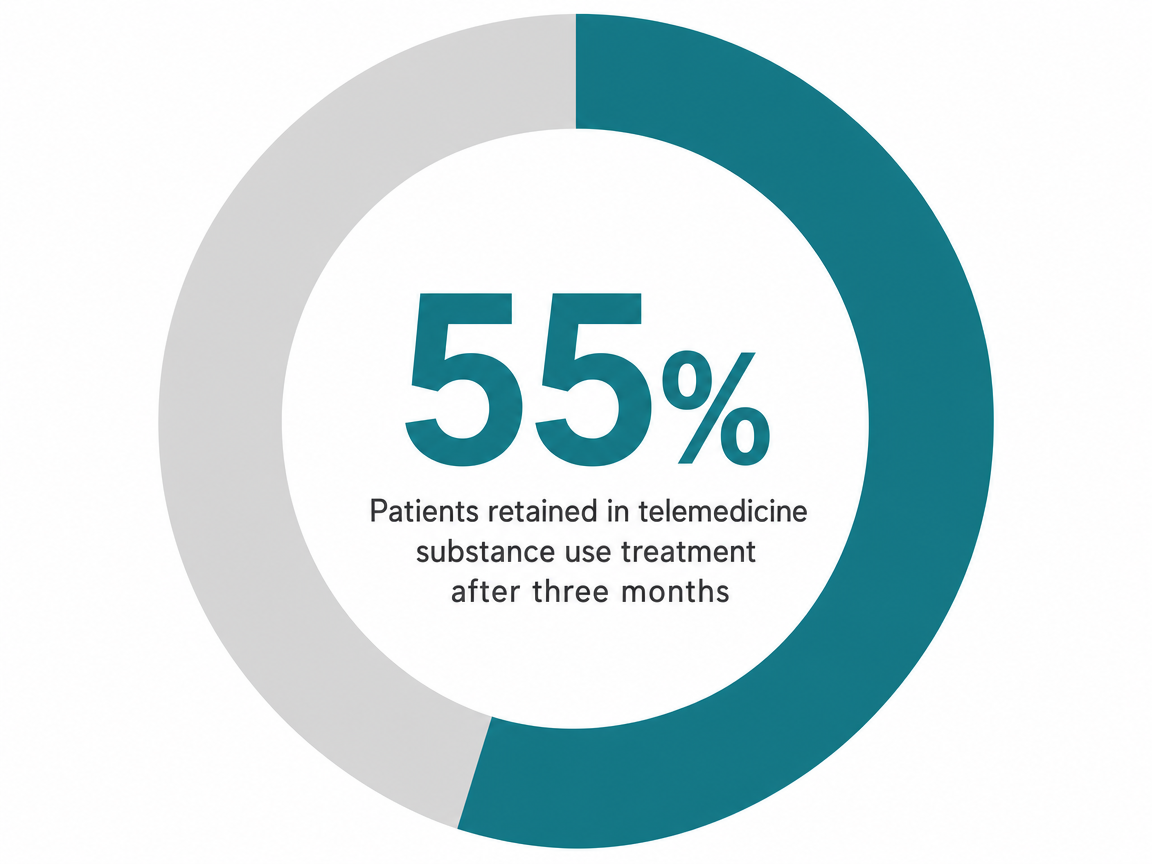
Now the part of the evidence that gets glossed over in most telehealth marketing: a study comparing in-person, fully virtual, and hybrid SUD programming found that people in hybrid programs stayed in treatment significantly longer than those in either fully virtual or fully in-person delivery. Set that next to the ~55% three-month retention benchmark for telemedicine-only care, and a more honest picture comes into focus. Virtual care holds its own. Hybrid, where some sessions happen in person and others by video, tends to hold people a bit longer.
What do you do with that as a working professional?
First, don't let it talk you out of starting virtually. The retention difference is meaningful at the population level; it's not a verdict on your individual outcome. The bigger risk for most working adults isn't "fully virtual versus hybrid"—it's not starting at all because the in-person option doesn't fit your life.
Second, treat hybrid as a future option, not a barrier. Many people begin fully virtual, build momentum, and later add in-person elements—a peer recovery meeting, a community group, a periodic prescriber visit. A good clinical team will help you layer those in when it makes sense, rather than treating virtual and in-person as opposing camps.
The honest read: virtual works. Hybrid may work a little better on retention. Your job is to pick the format you'll actually use this month, then adjust as your life and recovery evolve.
If alcohol is the substance you're thinking about, the evidence base for virtual delivery has a specific bright spot worth knowing. A 2025 study examining the post-COVID expansion of telehealth in SUD care found that a digitally delivered cognitive behavioral therapy intervention—"CBT Tech"—produced significantly positive findings on alcohol use that remained stable over 12 months.9
A few things stand out about that result. Twelve months is a serious follow-up window for SUD research; many studies stop at three or six. "Stable" matters because alcohol use disorder is notorious for early gains that fade. And CBT itself isn't a fringe modality—it's the same evidence-based therapy you'd get in a strong in-person program, just delivered through a screen with structured digital tools alongside it.
This doesn't mean every virtual program offering "CBT" is the same as the one studied. It does mean that when a Massachusetts virtual program tells you their clinical approach is built around mindfulness-based or cognitive behavioral therapy, that claim sits on real evidence—not on the assumption that any therapy delivered by video is automatically as good as one delivered in a room.
Choosing a level of care isn't about picking the program with the best website. It's about matching the intensity of treatment to where you actually are with your substance use, your mental health, and your week.
In Massachusetts, the practical choices for a working professional break down roughly like this:6
A candid intake assessment should land you in the right tier. If a program tries to sort you into a level of care before they've spent real time on your history, that's a signal to slow down and ask why.
For most working professionals dealing with substance use, the substance isn't the only thing going on. Anxiety that's been compounding for years. Depression that started before the drinking did, or after. Burnout that blurs the line between "I need a break" and "I need help."
A holistic virtual program treats these as one clinical picture, not two parallel tracks. Your therapist coordinates with your prescriber. Your treatment plan names both the SUD and the co-occurring condition. Group content includes emotional regulation, not just relapse prevention. When something shifts—a depressive stretch, a panic spike, a sleep collapse—your team adjusts the plan instead of referring you out.
One thing to be honest about: integrated co-occurring care is different from primary mental health treatment. If anxiety or depression is your main clinical issue and substance use is incidental, an SUD program isn't the right front door. If they're tangled together—each making the other worse—integrated SUD care with co-occurring support is built for exactly that situation.
When you're vetting programs, ask directly: "How do you handle co-occurring depression or anxiety?" A vague answer or a quick referral elsewhere tells you the integration is more marketing than clinical.
Privacy is the quiet reason a lot of working professionals never start treatment in the first place. You picture the parking lot of a clinic, someone you know driving past, the awkward calendar block your assistant can see. Virtual care removes most of that surface area—but only if you set it up deliberately.
A few practical things to think about:
MA-based patient research on telehealth outpatient SUD care found that most respondents rated telehealth as a satisfactory treatment modality, with individual therapy especially well-received. That satisfaction signal tracks with what the format actually solves: it gives you back the hours and the discretion that in-person care eats up.
Cost depends on three variables, and any program quoting you a flat number before they know all three is guessing.
The first is your level of care. Outpatient Services costs less per week than Day Treatment because you're using fewer clinical hours. The second is whether MAT is part of the plan—medication management visits and the prescriptions themselves add a line. The third, and usually the biggest, is your insurance.
If you're on MassHealth, virtual SUD services covered under the telehealth policy are reimbursed without the older physical-presence requirement getting in the way. That means individual therapy, group, and prescriber visits delivered by video are typically covered the same way an in-person visit would be. Confirm specifics with the program and your plan, but the policy floor is solid.4
If you have commercial insurance, ask the program for their in-network list and confirm your plan's behavioral health benefit—deductible, copay, and any prior authorization requirement for Day Treatment. Don't accept "we'll bill your insurance" as a complete answer.
Geography matters too. Rural research from Franklin County found the average resident travels 20 miles to reach SUD services. Virtual care collapses that distance to zero, which is part of why access in western and central Massachusetts has shifted so much in the last few years.3
The backdrop you're making this decision against matters. Massachusetts saw approximately 507 confirmed and estimated opioid-related deaths in just the first three months of 2024. The trend line has started bending in a more hopeful direction, but "better than the worst year" isn't the same as "solved." People are still dying, and the gap between who reaches treatment and who doesn't remains uneven across the state.8
That unevenness has a geography. Rural Massachusetts research found that the average resident of Franklin County travels 20 miles to reach SUD services. Twenty miles is a workday's worth of obstacle when you're already exhausted, ambivalent, or trying to keep a job intact. Virtual care doesn't eliminate every barrier, but it removes that one entirely.3
It also has a demographic dimension. Research on MA opioid overdose patterns has documented increasing deaths among Hispanic and other underserved populations in the state. Equitable access to care—care that fits language, schedule, and life circumstances—is part of what virtual delivery makes possible when it's done well.12
None of this is reason to rush a decision. It's context for taking the one you're already considering seriously.
By the time you're ready to actually pick a program, the marketing language starts to blur together. Here's a short list of questions that cut through it fast.5
If the answers are concrete, you've found a program worth a real conversation. If they're not, you've saved yourself weeks.
Yes. Legitimate virtual programs operate under the same BSAS licensing framework as in-person SUD providers, with clinical services authorized under 105 CMR 164. The legitimacy question isn't "in-person versus virtual"—it's whether the specific program is BSAS-licensed under a defined service category like Outpatient Services or Day Treatment, and whether the clinicians are appropriately credentialed. Ask directly; a real provider will answer specifically.4
In a clinically grounded program, holistic means coordinated care across several components: individual therapy (often mindfulness-based or cognitive behavioral), group therapy, medication-assisted treatment when appropriate, peer recovery coaching, integrated co-occurring mental health support, and family involvement when you want it. It's not spa language—it's a treatment plan that addresses your substance use, mental health, and life circumstances as one connected picture rather than separate appointments.
Yes, in most cases. MassHealth permits qualified providers to deliver covered SUD services—including MAT visits with a prescriber—via telehealth, regardless of older physical-presence requirements. Buprenorphine, Suboxone, and naltrexone can typically be initiated and managed virtually within current federal and state rules. Ask the program how their prescribers handle induction, follow-up cadence, and any periodic in-person requirements specific to your medication and history.5
Not from your treatment record. HIPAA protects your clinical information from your employer, and SUD records have additional federal protection under 42 CFR Part 2. Treatment isn't reportable unless you hold a safety-sensitive license with specific disclosure rules—worth raising with your clinician at intake if it applies to you. Beyond that, virtual sessions taken from a private space with a generic calendar block keep your care genuinely discreet.
MassHealth explicitly covers virtual SUD services under its telehealth policy, with the older physical-presence requirement removed. Most major commercial plans in Massachusetts also cover behavioral health telehealth at rates comparable to in-person, though specifics vary by plan. Ask the program for their in-network list, your deductible and copay for behavioral health, and whether Day Treatment requires prior authorization. Get the answer in writing before intake.4
PHP and IOP are common marketing terms, but BSAS doesn't license programs under those labels in Massachusetts. The BSAS-licensed category that maps to what other states call IOP is Day Treatment—typically 9 to 15 clinical hours per week. Outpatient Services covers lower-intensity care, often a few hours weekly. When comparing programs, ask which BSAS service category they're licensed under rather than which marketing acronym they use.6
November 6, 2025

November 6, 2025

November 6, 2025