Written and reviewed by the leadership team at Pathfinder Recovery, including licensed medical and clinical professionals with over 30 years of experience in addiction and mental health care.
Key Takeaways
Virtual detox in Connecticut is ASAM Level I-D care delivered remotely, with daily clinician contact during the first four days and clear criteria for who fits and who needs a higher level of care.16,17
Connecticut's drug supply has shifted hard toward fentanyl and xylazine, with fentanyl involved in 86% of 2024 overdose deaths, making unsupervised home withdrawal a gamble against an unpredictable bloodstream.1
The 2025 SAMHSA and DEA final rule lets a Connecticut-licensed, DEA-registered clinician start buprenorphine over video and continue prescribing through telehealth up to a six-month total supply before an in-person visit.7,8
Bring concrete questions to the first call — ASAM level, daily contact plan, escalation pathway, day-eight handoff — and disclose every substance in the picture so the clinician can build the right plan.
Deciding whether to detox from home in Connecticut
If you're reading this, you're already doing something hard. You're trying to figure out whether withdrawal from alcohol, opioids, or another substance can really be managed from your own home in Connecticut — safely, privately, and with actual medical care behind it. That's a serious question, and it deserves a serious answer.
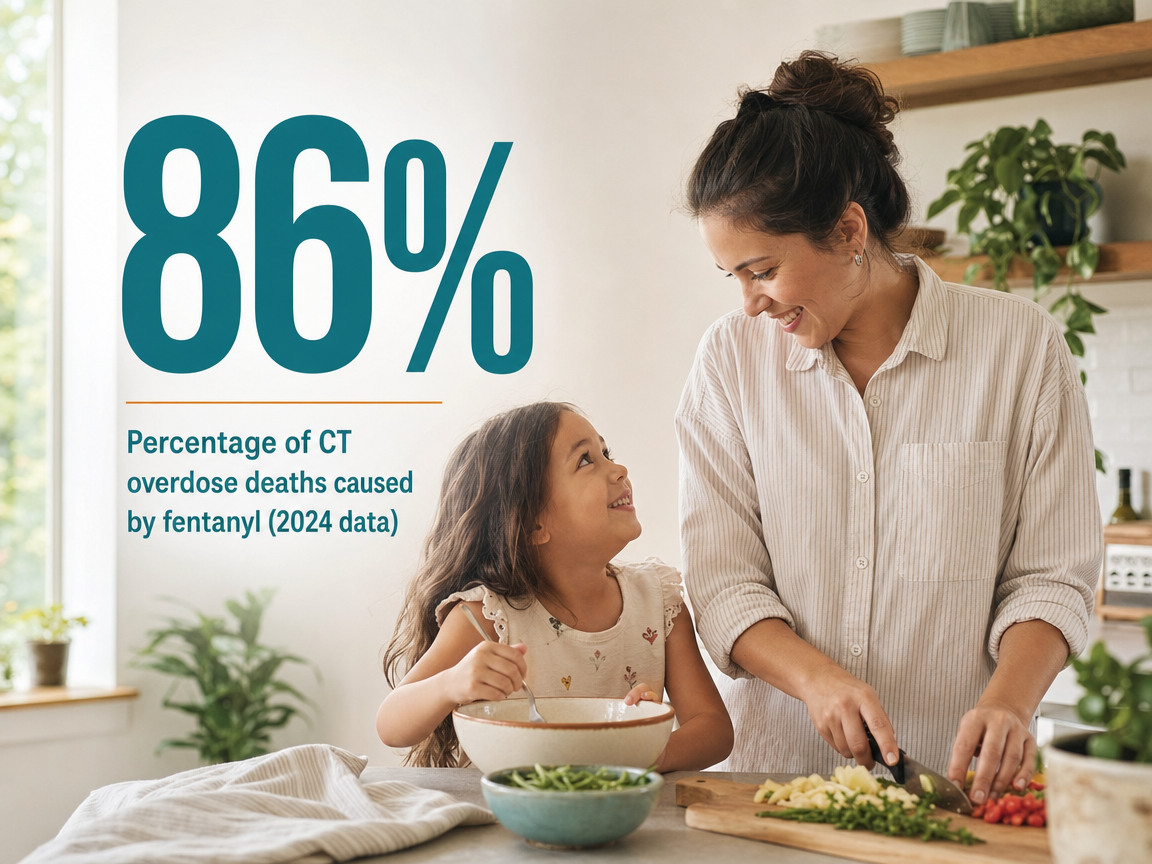
Connecticut has been living inside the overdose crisis for years. In 2024, the state recorded 928 unintentional overdose deaths, and fentanyl was involved in 86% of them. That context matters, because it shapes what supervised detox needs to look like here — not what it looked like a decade ago.1
Virtual detox isn't a softer version of treatment. It's a specific level of medical care, with rules about who fits, what medications are used, and when home is the wrong setting. This guide walks you through what virtual detox actually involves in Connecticut, who it suits, who it doesn't, what the 2025 federal telehealth rules changed about medication access, and the exact questions you can bring to a clinician. You don't have to decide anything today. Reading this is already a step.
Percentage of CT overdose deaths caused by fentanyl (2024 data)
What virtual detox actually is (and what it isn't)
The clinical definition: ASAM Level I-D, delivered remotely
When clinicians talk about detox, they don't mean one thing. The American Society of Addiction Medicine sorts withdrawal management into levels of care, and each level matches a different degree of medical risk. Virtual detox lives at the lowest-intensity end of that ladder, called Level I-D: an organized outpatient service where trained clinicians deliver medically supervised evaluation, withdrawal management, and referral on a set schedule — including, in some cases, in the patient's home.16
That last detail is the one most people miss. Level I-D was already a recognized level of care before telehealth scaled up. Video visits, secure messaging, and remote symptom check-ins are the delivery method. The underlying care — a clinician assessing you, prescribing medication when appropriate, watching your vitals and symptoms day by day — is the same care described in addiction medicine textbooks.
The other rungs of the ladder matter because they tell you what virtual detox is not.16
Level II-D is intensive outpatient withdrawal management with more frequent contact.
Level III.2-D is clinically managed residential detox, where you sleep at a facility with non-medical staff on hand.
Level III.7-D is medically monitored inpatient detox, with 24-hour nursing and physician oversight for people whose withdrawal could turn dangerous.
If a clinician steers you toward a higher level, that isn't a rejection. It's a judgment that your specific physiology — your history of seizures, your other health conditions, the substances involved — needs more eyes on it than a screen can provide. The level matches the risk, not the person's worth.
What a virtual detox week looks like in practice
Most people picture detox as a hospital bed and a heart monitor. A virtual detox week looks different, and the rhythm is closer to what general practitioners and addiction nurses have done in home settings for years.
The first day is the longest one. You'll typically have an intake call — often an hour or more — with a clinician who reviews your use history, other medications, medical conditions, mental health, and what's actually in your home: a support person, a quiet room, a way to reach 911 if needed. If you're a fit for Level I-D, the clinician writes a plan, sends prescriptions to your pharmacy, and books your next check-in.
From there, expect daily contact for at least the first several days. Home detox protocols for alcohol withdrawal call for daily review by a clinician for at least the first four days, and the same close cadence applies to opioid withdrawal management. Some visits are video, some are quick phone check-ins, some are symptom scores you send through an app. A support person at home — partner, parent, adult child, close friend — usually plays a role: holding medications, watching for warning signs overnight, calling the clinical team if something changes.17
By the end of the week, the conversation shifts from "are you safe right now" to "what's next." That handoff into ongoing treatment is part of the design, not an afterthought. A detox that ends with no follow-up is a detox that often doesn't hold.
Why supervision matters more in Connecticut's current drug supply
Here's the part of the conversation that gets glossed over: the drugs sold in Connecticut today are not the drugs sold here ten years ago, and that changes what unsupervised withdrawal can do to you. If you're considering detox at home, the supply you've been using is the reason supervision isn't optional.
Fentanyl has been the dominant story for a while. In 2024, it was involved in 86% of Connecticut overdose deaths. Surveillance data from the second week of June 2025 showed fentanyl involved in 71.2% of confirmed overdose deaths that year, with xylazine — a veterinary sedative that's not an opioid and doesn't respond to naloxone — showing up in 13.9%. If you've been using street opioids in Connecticut recently, there's a real chance xylazine has been in your system without your knowing it, and its withdrawal pattern doesn't follow the opioid script clinicians were trained on a decade ago.1,2
That matters for a home detox plan in three concrete ways.
Your last dose probably wasn't what you thought it was, which makes self-managing the taper guesswork at best.
Xylazine withdrawal can produce anxiety, restlessness, and elevated vitals that buprenorphine alone won't fully address — a clinician needs to see those symptoms and adjust.
The wound complications and sedation patterns associated with xylazine sometimes require medical eyes that a peer or family member can't provide.
None of this is a reason to give up on detoxing at home. It's a reason to do it with a clinician who knows the current supply, checks in daily, and can escalate the level of care if your symptoms tell them to. White-knuckling withdrawal alone in 2025 isn't brave. It's a gamble with what's actually in your bloodstream.
Who virtual detox is wrong for — read this first
Before you read about who fits, you need to read about who doesn't. This is the part of the conversation that home detox marketing usually skips, and it's the part that keeps people alive.
Home detox is not safe for everyone. Clinical protocols are explicit about it: a history of withdrawal seizures, delirium tremens, serious medical illness, severe psychiatric symptoms, pregnancy, or a lack of a reliable support person at home are all reasons to choose a higher level of care. If you've ever had a seizure coming off alcohol or benzodiazepines, your next withdrawal carries real risk of another one — and a seizure that happens alone in a bedroom is a different event than a seizure that happens with a nurse in the room.17
The honest red-flag list looks like this. If any of these describe you, virtual detox is probably the wrong setting:
You've had a withdrawal seizure or DTs before, at any point in your life.
You're using high daily amounts of alcohol or benzodiazepines, especially both together.
You have unstable heart, liver, or lung disease, uncontrolled diabetes, or you're pregnant.
You're having active thoughts of suicide or recent psychiatric hospitalization.
You don't have a sober, reachable adult who can stay with you for the first several days.
Your home isn't physically safe — active violence, ongoing use by others in the house, or no privacy for clinical calls.
Saying yes to any of these doesn't mean you can't recover. It means the first chapter happens with more medical presence than a screen can hold — Level III.2-D or III.7-D care, where nursing and physician oversight are in the same building as you. That's not a setback. That's the right tool for what your body is actually doing.16
Who is a reasonable fit for virtual detox
If the red-flag list didn't describe you, the next question is whether the green-flag picture does. Virtual detox tends to work for people whose withdrawal is medically predictable and whose home environment can hold them steady for a week.
A reasonable fit usually looks something like this: you're a Connecticut adult with a moderate use pattern, no history of complicated withdrawal, and your other health conditions are stable enough that your primary care doctor isn't worried about you day-to-day. You have a support person who can stay with you — or check in several times a day — for at least the first four days, which is the window when daily clinician review matters most. You have a quiet, private space to take video visits. You have a phone that works, a pharmacy you can reach, and a way to get to an emergency department quickly if something changes.17
Motivation matters too, but not in the way recovery advertising suggests. You don't need to feel certain. You need to be willing to answer the phone, take the medication as prescribed, and tell the truth about your symptoms — even the embarrassing ones. That honesty is what lets a clinician keep you at Level I-D instead of moving you up the ladder.16
What medications you can actually start from home
Buprenorphine after the 2025 federal rule
For opioid withdrawal, the medication that does the most work is buprenorphine. It binds to the same receptors as fentanyl and heroin, calms the worst of the symptoms within hours, and lowers overdose risk during the fragile early weeks. The question for years was whether you could start it without first sitting in a clinic. As of 2025, the answer in Connecticut is yes, in most cases.
SAMHSA and the DEA issued a final telemedicine rule in 2025 that made the pandemic-era buprenorphine flexibilities permanent. In practical terms, a Connecticut clinician who is DEA-registered and licensed in the state can evaluate you over a video visit — or, when video isn't possible, an audio-only call — and prescribe buprenorphine without requiring you to come in first. You can begin treatment and receive up to a six-month total supply through telehealth before an in-person visit is needed. Separately, a Federal Register rule extended broader telemedicine flexibilities for other controlled medications through December 31, 2026, which keeps the regulatory floor stable while permanent rules are finalized.6,7,8
What this means for you: if your intake clinician confirms opioid use disorder and you're in mild-to-moderate withdrawal — usually the morning after your last dose — they can call in a starter prescription the same day. The first dose is timed to when you're feeling sick enough that buprenorphine won't trigger precipitated withdrawal. That timing is something your clinician walks you through hour by hour. You don't have to figure it out alone.
Alcohol and benzodiazepine withdrawal: the medication picture is different
Opioid withdrawal is miserable but rarely lethal on its own. Alcohol and benzodiazepine withdrawal can be. That difference shapes what medications a clinician will and won't manage from your home.
For alcohol, the standard medication is a benzodiazepine taper — usually long-acting agents like chlordiazepoxide or diazepam — dosed down across several days to prevent seizures and quiet the autonomic storm of withdrawal. Home protocols for alcohol detox use this approach successfully for carefully chosen patients, paired with daily clinician review for at least the first four days, thiamine and other nutritional support, and a sober support person on site. What disqualifies you from this pathway is the same list from earlier: prior seizures, DTs, heavy daily drinking with no eating, unstable medical issues. In those cases, the medications still get used — just inside a facility with nursing around the clock.16,17
Benzodiazepine withdrawal is a different animal. There's no shortcut taper from home for someone using high daily doses, and abrupt stopping can cause seizures that arrive days into the process. If benzodiazepines are part of your picture, expect a clinician to slow everything down, often coordinating a months-long taper rather than a week of detox. That's not failure. That's the medication doing what it should.
Polysubstance use: when detox isn't a single-substance event
Most people walk into a first conversation about detox naming one substance. The truth is usually messier. If you've been using opioids in Connecticut, there's a strong chance something else is in the mix — a stimulant like cocaine or methamphetamine, alcohol after a hard week, a benzodiazepine you started taking for sleep. A virtual detox plan that treats your situation as a single-substance event will miss what your body is actually doing.
The national picture is blunt about it. CDC data covering January 2021 through June 2024 found that 59.0% of U.S. overdose deaths involved stimulants, and 43.1% co-involved stimulants and opioids. Stimulants and opioids aren't separate lanes anymore. They're often in the same person, sometimes in the same bag.11
That changes what a clinician asks you during intake, and what you should be ready to answer honestly. Stimulant withdrawal doesn't usually need medication, but the crash — deep fatigue, low mood, sometimes intense cravings — can land hard in the same week your body is processing opioid withdrawal. Alcohol on top of opioids raises the seizure-risk calculation and may shift you out of Level I-D entirely. Benzodiazepines in the picture almost always slow the plan down.16
What helps here is telling the full list on day one, even the parts that feel embarrassing. A clinician can build around what's actually in your system. They cannot build around what you leave out.
Connecticut's telehealth posture and what it means for access
Connecticut has been quietly building the policy scaffolding for virtual addiction care since the pandemic forced the experiment open. The state's own Telehealth Analysis Report concluded that telehealth is a promising option for opioid use disorder treatment and that telehealth substance use disorder visits have been shown to be as effective as in-person visits. That sentence matters because it's the state, not a vendor, saying the modality holds clinical weight.14
The federal floor under that posture is steadier than it was even a year ago. The 2025 SAMHSA and DEA final rule made buprenorphine telemedicine prescribing permanent , and a separate Federal Register extension keeps the broader telemedicine flexibilities for other controlled medications in place through December 31, 2026. For you, that combination means a Connecticut-licensed clinician can start your detox and your medication on the same video visit, and that pathway isn't scheduled to disappear mid-treatment.6,7
Access still depends on finding a provider licensed in Connecticut who takes your insurance. The legal door is open. Walking through it is the part you do next — usually by calling, sometimes by filling out an intake form, often by being honest about what you've been using.
Recovery, Made Possible — From Home
Pathfinder Recovery offers in-home addiction and mental health treatment that fits your life — not the other way around. From at-home detox and MAT to virtual IOP and peer support, our licensed clinicians bring evidence-based care to you through secure telehealth.
The first call with a virtual detox provider can feel like an interview going one direction — them asking, you answering. It works better when it goes both ways. The questions below are the ones a thoughtful Connecticut patient or family member can bring to that intake, written so you can read them off a piece of paper if your brain is tired.5,8,16,17
Are you licensed to practice in Connecticut, and is your prescriber DEA-registered? Both are required for legal remote prescribing of buprenorphine or a benzodiazepine taper from your home.
Which ASAM level of care are you placing me in, and why not a higher level? You want them to name Level I-D out loud and explain what would move you up the ladder.
What's the daily contact plan for the first four days? Home alcohol protocols call for daily clinician review during that window — ask what yours looks like and who runs it.
If I start buprenorphine, how long can you continue prescribing it through telehealth before I need an in-person visit? Under the 2025 final rule, that window can extend up to a six-month total supply.
What's your escalation plan if my symptoms get worse — and who do I call at 2 a.m.?
How do you handle xylazine, stimulants, or benzodiazepines if they're also in the picture?
What does the handoff to ongoing treatment look like on day eight?
If a provider can't answer these clearly, that's information too. You're allowed to keep looking.
What comes after detox: the handoff that decides outcomes
The week of withdrawal is the part most people fixate on, but it isn't the part that decides whether you stay well. The handoff into ongoing treatment — what happens on day eight, day fifteen, day sixty — is where the real work lives. A detox that ends with a wave goodbye and a phone number is a detox that often comes undone.
For opioid use disorder, the strongest version of that handoff is continuous medication. The 2025 final rule lets a Connecticut clinician keep prescribing buprenorphine through telehealth for up to a six-month total supply before an in-person visit is required, which means your detox prescriber and your maintenance prescriber can be the same person. That continuity matters. Every transfer between providers is a place where people fall out of care.8
The other piece is behavioral support, and this is where co-occurring conditions deserve naming. The CDC found that 37% of people who died from overdose in 2024 had evidence of a mental health diagnosis. Depression, anxiety, and trauma don't pause for withdrawal — they often surface louder once the substance is gone. A solid handoff includes individual therapy, peer recovery support, and, when needed, integrated treatment for co-occurring mental health concerns alongside your SUD care.12
Ask your detox provider on day one what day eight looks like. If they can answer that clearly, you're in the right hands.
Experience Virtual Healing With Pathfinder Recovery
If you or a loved one are ready to create a life you love—without having to sacrifice your work, family, and responsibilities—we're here to support you on that journey. Contact us today for personalized care from the comfort of your own home. We will work with your insurance provider so you can focus on what really matters: recovery.
Frequently Asked Questions
Is virtual detox actually safe, or is it a watered-down version of real treatment?
It's real treatment when it's the right level for your body. Connecticut's own Telehealth Analysis Report concluded that telehealth substance use disorder visits have been shown to be as effective as in-person visits. What makes it safe is the screening — a clinician matching you to Level I-D care only if your withdrawal pattern fits, then checking in daily during the riskiest window. Safety lives in the selection, not the screen.14
Can I get buprenorphine prescribed during a virtual detox in Connecticut without an in-person visit first?
Yes, in most cases. A Connecticut-licensed, DEA-registered clinician can evaluate you over video — or audio-only when video isn't available — and send a buprenorphine prescription to your pharmacy that day. Under the 2025 final telemedicine rule, you can receive up to a total six-month supply through telehealth before an in-person visit is required. Ask the intake clinician to confirm their Connecticut licensure and their DEA registration on the first call.8
What happens if my withdrawal symptoms get worse than expected at home?
A real virtual detox program has an escalation plan written before day one. That usually means a 24-hour clinical line, clear thresholds for when you call 911 versus when you call the team, and a pre-identified emergency department. If symptoms cross the line — seizure activity, severe vomiting, chest pain, confusion — your clinician moves you up the ASAM ladder to Level III.2-D or III.7-D care. Ask exactly who answers at 2 a.m.16
Does insurance in Connecticut cover virtual detox the same as in-person detox?
Most Connecticut commercial plans and HUSKY (Medicaid) cover telehealth-delivered SUD services on par with in-person care, reflecting the state's broader telehealth posture. Coverage details vary by plan, deductible, and which medications are on formulary. Call the number on your insurance card and ask specifically about outpatient withdrawal management, buprenorphine coverage, and telehealth behavioral health benefits. A good intake team will run that verification with you before you start.14
Can I detox from alcohol or benzodiazepines virtually, or is that only for opioids?
Alcohol detox can happen virtually for carefully selected patients — moderate intake, no seizure history, stable health, a sober support person at home, and daily clinician review for at least the first four days. Benzodiazepines almost never fit a one-week home detox; clinicians typically design a months-long taper instead. If you're using both alcohol and benzodiazepines daily, expect a facility-based recommendation. That's the medication doing its job, not a door closing.17
How do I bring up virtual detox with my family or employer without disclosing everything?
You don't owe anyone your full medical history. With family, naming the support role you need — "stay with me this week, hold these medications" — is often enough. With an employer, FMLA or short-term disability paperwork describes "a serious health condition" without specifying the diagnosis; HR sees dates, not details. Federal privacy protections for SUD records are stronger than for general health information. Start with what you need them to do, not what you've been doing.
No items found.
[{"@context":"https://schema.org","@type":"BlogPosting","headline":"CT Virtual Detox: What You Need to Know","description":"Learn how virtual detox in CT offers remote, supervised care with daily clinician support and safe medication options for effective withdrawal management.","publisher":{"@type":"Organization","name":"Pathfinder Recovery"},"mainEntityOfPage":{"@type":"WebPage","@id":"https://www.pathfinder-recovery.com"}},{"@context":"https://schema.org","@type":"MedicalWebPage","headline":"CT Virtual Detox: What You Need to Know","description":"Learn how virtual detox in CT offers remote, supervised care with daily clinician support and safe medication options for effective withdrawal management.","mainEntityOfPage":{"@type":"WebPage","@id":"https://www.pathfinder-recovery.com"}},{"@context":"https://schema.org","@type":"FAQPage","mainEntity":[{"@type":"Question","name":"Is virtual detox actually safe, or is it a watered-down version of real treatment?","acceptedAnswer":{"@type":"Answer","text":"It's real treatment when it's the right level for your body. Connecticut's own Telehealth Analysis Report concluded that telehealth substance use disorder visits have been shown to be as effective as in-person visits. What makes it safe is the screening \u2014 a clinician matching you to Level I-D care only if your withdrawal pattern fits, then checking in daily during the riskiest window. Safety lives in the selection, not the screen."}},{"@type":"Question","name":"Can I get buprenorphine prescribed during a virtual detox in Connecticut without an in-person visit first?","acceptedAnswer":{"@type":"Answer","text":"Yes, in most cases. A Connecticut-licensed, DEA-registered clinician can evaluate you over video \u2014 or audio-only when video isn't available \u2014 and send a buprenorphine prescription to your pharmacy that day. Under the 2025 final telemedicine rule, you can receive up to a total six-month supply through telehealth before an in-person visit is required. Ask the intake clinician to confirm their Connecticut licensure and their DEA registration on the first call."}},{"@type":"Question","name":"What happens if my withdrawal symptoms get worse than expected at home?","acceptedAnswer":{"@type":"Answer","text":"A real virtual detox program has an escalation plan written before day one. That usually means a 24-hour clinical line, clear thresholds for when you call 911 versus when you call the team, and a pre-identified emergency department. If symptoms cross the line \u2014 seizure activity, severe vomiting, chest pain, confusion \u2014 your clinician moves you up the ASAM ladder to Level III.2-D or III.7-D care. Ask exactly who answers at 2 a.m."}},{"@type":"Question","name":"Does insurance in Connecticut cover virtual detox the same as in-person detox?","acceptedAnswer":{"@type":"Answer","text":"Most Connecticut commercial plans and HUSKY (Medicaid) cover telehealth-delivered SUD services on par with in-person care, reflecting the state's broader telehealth posture. Coverage details vary by plan, deductible, and which medications are on formulary. Call the number on your insurance card and ask specifically about outpatient withdrawal management, buprenorphine coverage, and telehealth behavioral health benefits. A good intake team will run that verification with you before you start."}},{"@type":"Question","name":"Can I detox from alcohol or benzodiazepines virtually, or is that only for opioids?","acceptedAnswer":{"@type":"Answer","text":"Alcohol detox can happen virtually for carefully selected patients \u2014 moderate intake, no seizure history, stable health, a sober support person at home, and daily clinician review for at least the first four days. Benzodiazepines almost never fit a one-week home detox; clinicians typically design a months-long taper instead. If you're using both alcohol and benzodiazepines daily, expect a facility-based recommendation. That's the medication doing its job, not a door closing."}},{"@type":"Question","name":"How do I bring up virtual detox with my family or employer without disclosing everything?","acceptedAnswer":{"@type":"Answer","text":"You don't owe anyone your full medical history. With family, naming the support role you need \u2014 \"stay with me this week, hold these medications\" \u2014 is often enough. With an employer, FMLA or short-term disability paperwork describes \"a serious health condition\" without specifying the diagnosis; HR sees dates, not details. Federal privacy protections for SUD records are stronger than for general health information. Start with what you need them to do, not what you've been doing."}}]}]
Pathfinder Recovery offers in-home addiction and mental health treatment that fits your life — not the other way around.From at-home detox and MAT to virtual IOP and peer support, our licensed clinicians bring evidence-based care to you through secure telehealth.
The Pathfinder Recovery App and Smart Ring keep your care team connected to your progress between sessions — monitoring sleep, stress, and recovery milestones in real time.It’s proactive, private, and personalized — so support is always within reach.
Mental Health Help Online made accessible with Pathfinder Recovery—offering virtual care that breaks barriers, supports healing, and builds a stronger future.
Explore MAT Treatment Virtual with Pathfinder—compassionate, evidence-based medication-assisted care delivered online for safe, flexible, and effective recovery support.