
Exploring Types of Addiction Treatment for Working Moms
Explore Addiction Treatment for Working Moms. Pathfinder Recovery explains treatment options that help busy mothers find flexible, supportive recovery care.

February 5, 2026


Written and reviewed by the leadership team at Pathfinder Recovery, including licensed medical and clinical professionals with over 30 years of experience in addiction and mental health care.
If you're reading this after a difficult conversation with your adult child, know that Massachusetts provides a robust virtual infrastructure for families navigating substance use challenges. This support is often free, confidential, and readily accessible.
The state's resources include the Behavioral Health Help Line, available 24/7 via phone, text, and chat, which offers support to family members, not just the individual using substances 3. The Massachusetts Substance Use Helpline serves as the primary statewide public resource for locating substance use treatment and recovery services, including telehealth options that align with insurance coverage 3. Additionally, Peer Recovery Support Centers across Massachusetts are peer-led environments that welcome families and allies, extending beyond individuals in recovery 4. The Bureau of Substance Addiction Services oversees and funds these treatment programs and counselors, ensuring their credentials and quality 13.
MassHealth covers telehealth-eligible outpatient behavioral health and substance use services at the same rate as in-person care, encompassing live video and audio-only visits 1. This means virtual family sessions, groups, and clinician appointments are recognized as legitimate components of care. Research highlights the significant role family involvement plays in a loved one's recovery 12, underscoring the importance of seeking support for yourself as a caregiver.
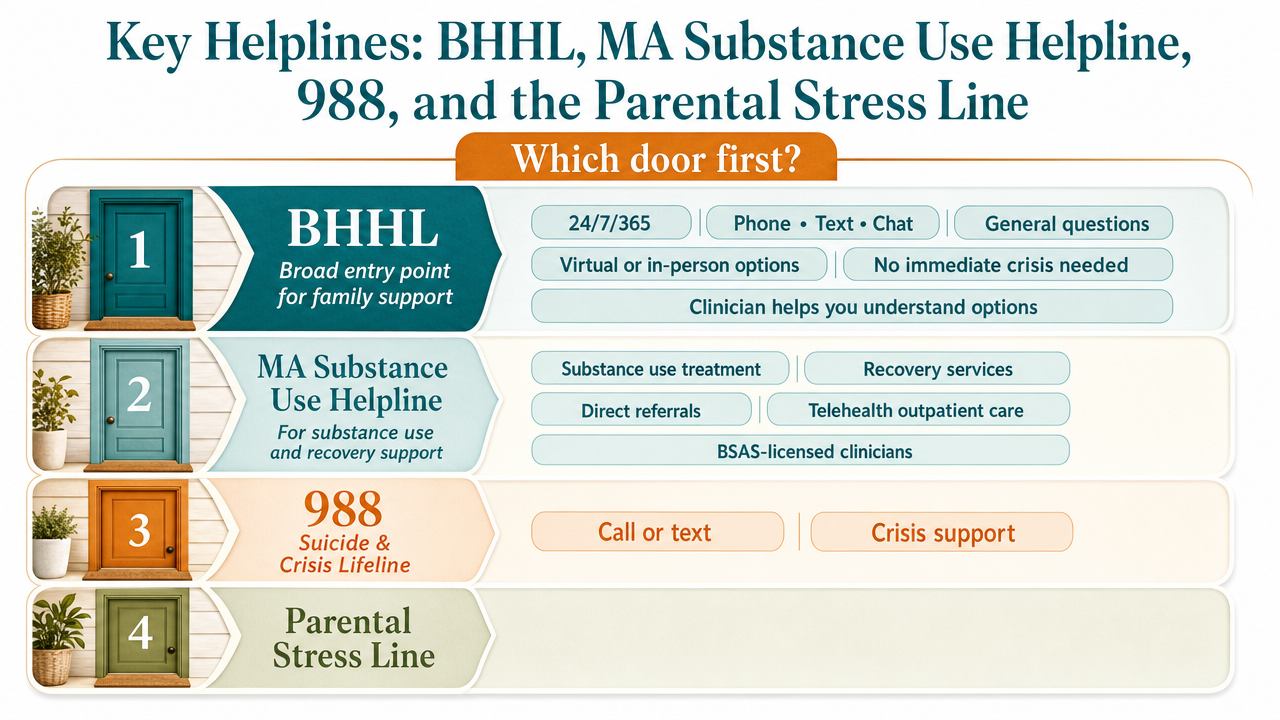
Massachusetts offers several distinct entry points, each designed for different needs and moments in your journey.
The Behavioral Health Help Line (BHHL) is a comprehensive resource available 24/7/365 via phone, text, or chat 3. It's suitable for general inquiries and connecting with virtual or in-person options, even if there isn't an immediate crisis. A clinician can help you understand the situation and navigate available services.
The Massachusetts Substance Use Helpline is the state's dedicated public resource for finding substance use treatment and recovery services 3. Use this line for direct referrals to specific programs, including telehealth outpatient care or Bureau of Substance Addiction Services–licensed clinicians 13.
988 is the Suicide and Crisis Lifeline. Contact them via call or text if your adult child is discussing self-harm, is unresponsive, or if you are experiencing overwhelming distress yourself 6. This resource is for both individuals in crisis and their families.
The Parental Stress Line is specifically for caregivers 6. It offers support when you need to connect with someone who understands the challenges of parenting an adult child facing these issues, rather than seeking treatment information.
Additional resources include Boston Medical Center's Addiction Warmline and Safespot, both recognized Massachusetts family-facing supports 2. These provide alternative contact points if primary lines are busy.
A comparison of these resources can help you decide which to contact first:
| Door | Hours | How to reach | Who it serves | Cost |
|---|---|---|---|---|
| Behavioral Health Help Line | 24/7/365 | Phone, text, chat | Family and loved one | Free, confidential 3 |
| MA Substance Use Helpline | Statewide, ongoing | Phone | Both, treatment-finder focus | Free, confidential 3 |
| 988 Lifeline | 24/7 | Phone, text, chat | Both, crisis | Free 6 |
| Parental Stress Line | Varies | Phone | Caregiver only | Free 6 |
| BMC Addiction Warmline | Varies | Phone | Both | Free 2 |
| Safespot | Varies | Phone | Both | Free 2 |
If your initial call isn't the right fit, the person on the line can often direct you to the appropriate resource.
"I'm calling about my adult child. They're struggling with substance use, and I'm not sure what I need yet. I just know I need to talk to someone who knows the Massachusetts system."The professional on the other end will guide the conversation from there.
To be more prepared, have your loved one's approximate age and city, a description of what you're observing (e.g., alcohol, opioids, stimulants, mental health concerns), and your insurance card ready. You are not obligated to share any of this information, but it can be helpful if requested.
Consider asking these questions during your first conversation:
Securing one new contact or piece of information from your first call is a significant step forward.
It is permissible, and often beneficial, for you to seek support before your adult child does. Research from SAMHSA emphasizes that family support is crucial for individuals with mental health or substance use conditions, and caregivers are encouraged to seek support for themselves 12. Your well-being is integral to your child's recovery journey.
Joining a family-only virtual group in the early stages offers unique benefits. It connects you with other parents who have faced similar challenges, provides language to articulate your observations, and helps establish a supportive routine before the next difficult situation arises.
You do not need your loved one's permission, a diagnosis, or a rehearsed story to attend. Simply showing up, even with your camera off or on mute, is a valuable step.
Massachusetts Peer Recovery Support Centers (PRSCs) are free, peer-led spaces that offer recovery support not only to individuals in recovery but also to their families and allies 4. This means you are welcome to participate independently.
PRSC programming varies but typically includes family groups, educational sessions, social activities, and connections to community resources. Many centers now provide virtual or hybrid options, allowing you to participate remotely from anywhere in the state. The Bureau of Substance Addiction Services funds and coordinates this network, ensuring accountability and integration with broader recovery services 13.
Contact the Behavioral Health Help Line to inquire about PRSCs in your area and their virtual family programming 3. Some centers offer caregiver-specific groups, while others facilitate mixed groups where families and individuals in recovery share space. Experiment with different options until you find a suitable fit.
When your adult child expresses readiness for treatment, it marks the beginning of a new phase, often involving family participation. Outpatient care and intensive outpatient programs (IOP) can be delivered in person or via telehealth, and family and marriage therapy are standard components of many treatment plans 14. This virtual delivery is a recognized and effective form of modern care.
A virtual outpatient program typically involves weekly individual therapy and, if needed, medication management. A virtual IOP usually includes three group sessions per week, often with a family session integrated every few weeks, once your loved one provides consent.
The process generally involves your adult child completing an intake and clinical assessment, meeting with a therapist and potentially a prescriber, and establishing a weekly routine. Within the first month, the clinician may discuss family involvement. If your loved one agrees, you will be scheduled for family sessions with specific objectives. This plan then progresses towards aftercare, where consistent family support becomes a vital element.
During your first family session, a clinician will establish ground rules, inquire about your expectations, and guide the conversation. This structured environment allows for open communication and emotional processing.
It's important to understand that your adult child's treatment records, session content, medication details, and even attendance are protected under HIPAA. Without their written consent, a program cannot disclose much beyond general information.
Practically, this means you may not be informed of specific diagnoses, session discussions, relapses, or medication regimens. However, you can receive general education about the condition, information on family support resources, and, with your loved one's signed release, participate in scheduled family sessions with defined topics.
Consider discussing a limited release with your adult child. This allows the clinician to share specific information, such as safety concerns or scheduling, without granting full access to their records. Many young adults are more amenable to a narrow release than a comprehensive one. If they decline initially, respect their decision, as their willingness may change over time.
In the interim, you can continue to work with your own therapist, join a family group, and develop skills that will be valuable when your loved one is ready to involve you more directly.
This is not a minor detail. If your adult child lives in Boston but their therapist is only licensed in New York, a licensure gap exists. If your loved one is a college student who moves between Amherst and a summer address in Connecticut, the provider needs to be licensed in both states, or sessions must pause when they cross state lines.
When contacting a virtual program, ask two key questions: Are your clinicians licensed in Massachusetts? And what happens if my adult child travels or moves? Programs that regularly serve the Northeast (MA, VT, NH, CT) are typically equipped to manage these interstate realities without interrupting care.
While you don't need to become an insurance expert, understanding key terms will help you ask the right questions when contacting your plan or a program's intake line, ensuring you don't miss out on covered services.
For MassHealth members, most mental health, drug, and alcohol services are accessible, and member services can assist in finding care that fits their plan 15. MassHealth reimburses telehealth-eligible outpatient behavioral health and substance use services at parity with in-person care, including live video and audio-only visits, provided the member consents and the provider documents the encounter and patient location 1. This means virtual therapy, IOP groups, or medication management via video are covered equally to in-office visits.
Commercial plans in Massachusetts generally follow similar telehealth coverage patterns, though specifics may vary. When calling member services, ask these four questions:
SAMHSA identifies family and marriage therapy as a standard component of many treatment plans 14, making this a relevant inquiry.
Remember that services accessed through the Behavioral Health Help Line and the Massachusetts Substance Use Helpline are free and confidential, regardless of insurance status 3. If insurance coverage presents a barrier, these helplines remain a viable option.
It's impossible to address everything at once. A phased approach allows for sustainable progress. Here's a suggested pacing plan:
Days 1 through 7: One call, one group, one boundary. Make one call to either the Behavioral Health Help Line or the Massachusetts Substance Use Helpline, choosing the one that feels most accessible 3. If you've already made this call, it counts. Attend one family-only virtual meeting this week, such as an online Al-Anon-style meeting or a caregiver group listed through Massachusetts family-facing supports like the Boston Medical Center Addiction Warmline network or Safespot 2. Participating with your camera off or on mute is perfectly acceptable. Establish one small, manageable boundary for yourself this week, such as "I will not answer texts after 10 p.m." or "I will reserve Sunday mornings for myself." Small boundaries are effective.
Days 8 through 30: Add a peer center and schedule an assessment. Contact a Peer Recovery Support Center in your region and attend one virtual family session or educational event that fits your schedule 4. Simultaneously, if your adult child is receptive, schedule a clinical assessment with a virtual outpatient program or intensive outpatient program. Both can be delivered via telehealth, and family or marriage therapy is often included in the treatment plan with your loved one's consent 14. The goal here is to get on the calendar, not to commit to a program yet.
Days 31 through 90: Transition from reacting to routine. By month two, your family group attendance should become a consistent habit. If your adult child has begun virtual outpatient or IOP, family therapy sessions will be scheduled within their care plan at a rhythm set by the clinician 14. You may have also started your own therapy or coaching for caregiver support, and you'll have a familiar contact at your PRSC 4. Around month three, aftercare planning will enter the conversation, whether your loved one is stepping down from IOP or maintaining weekly outpatient work. This is when the routines you established earlier begin to yield significant benefits.
If the plan encounters setbacks, which is common, you don't have to start over. Simply return to the last door you used and resume from there. This is a normal part of the recovery journey.
A truly effective support routine functions consistently, regardless of your adult child's progress. It's a stable framework that endures through both positive and challenging periods.
Focus on consistency. Commit to one weekly family group at a fixed time, whether your loved one is in aftercare or experiencing active use. Peer Recovery Support Centers can provide this consistent rhythm, as they welcome families at all stages of recovery 4. Incorporate a monthly check-in with your own therapist or coach; caregivers who prioritize their well-being are better equipped to provide long-term support, and family involvement is a significant factor in a loved one's recovery 12.
Keep the Behavioral Health Help Line readily accessible in your phone 3. If a relapse occurs, having the number one tap away can make a critical difference. A relapse does not signify failure of the plan; it indicates the plan is being utilized. Reconnect with the last resource you engaged with, communicate the changes, and allow them to help you adjust. If your adult child re-enters virtual outpatient or IOP, family sessions can be reintegrated with their consent 14. If not, your established routine provides continued stability. This consistent, personalized approach is the essence of building lasting support.
Yes. You do not need your adult child's permission or participation to seek support for yourself. The Behavioral Health Help Line will speak with family members directly, 24/7 by phone, text, or chat 3. Peer Recovery Support Centers also welcome families and allies independently 4. Family support plays a significant role in a loved one's recovery, and caregivers are encouraged to seek help for themselves 12.
Yes. MassHealth reimburses telehealth-eligible outpatient behavioral health and substance use services at parity with in-person care, including live video and audio-only visits, provided the member consents and the provider documents the encounter and patient location 1. MassHealth members have access to most services for mental health, drug, and alcohol issues, and member services can help locate care that fits their plan 15.
Without your adult child's written consent, very little information can be shared due to HIPAA regulations protecting their records, session content, medications, and attendance. You can receive general education about the condition and information about family resources. If your loved one signs a limited release, the clinician can share specific items like safety concerns or scheduling. Many young adults agree to a narrow release when they might refuse a broader one.
Call the Behavioral Health Help Line first. It operates 24/7/365 via phone, text, and chat, and a clinician can help you assess the situation and direct you to the appropriate next step 3. If you specifically need assistance finding substance use treatment, the Massachusetts Substance Use Helpline is the dedicated public resource 3. For crisis situations, call or text 988 6.
The provider needs to be licensed in Massachusetts, not necessarily physically located here. Telehealth care is governed by the laws of the patient's location, so a clinician treating a Massachusetts resident must hold a Massachusetts license 5. If your adult child travels or moves between states, the provider needs the appropriate license for each location, or sessions will pause when they cross state lines. Ask about this directly during intake.
SAMHSA indicates that outpatient care can be delivered effectively in person or via telehealth, highlighting telehealth as a strong option for those with appointment access challenges 14. Family and marriage therapy is a standard component of treatment plans across both modalities 14. MassHealth reimburses virtual outpatient behavioral health at parity with in-person care 1. The effectiveness of care is more dependent on its structure and evidence-based approach than on the delivery method.
February 5, 2026

November 6, 2025

November 7, 2025