Written and reviewed by the leadership team at Pathfinder Recovery, including licensed medical and clinical professionals with over 30 years of experience in addiction and mental health care.
Key Takeaways
Connecticut formalizes peer coaching through DMHAS, ORCA, and Recovery University, giving you a named credential, code of ethics, and training pipeline you can verify before committing 1, 3, 5.
The state is transitioning to the CPSRP credential, with a grandparenting window closing October 1, 2026 and a two-year renewal cycle requiring 10 CE hours annually 4.
Peer coaches share lived experience to support daily recovery work but do not diagnose, prescribe, or replace therapy, making them most useful alongside clinical care after detox, IOP, or a slip 5, 10.
Before booking, ask any Connecticut coach about their CPSRP status, Recovery University or DMHAS-endorsed training, recent continuing education, and how they coordinate with your clinicians 3, 4.
Why Connecticut Is a Different Conversation About Peer Coaching
If you're reading this on a quiet break between meetings, you already know the basics of recovery. You don't need a primer. What you need is a clear-eyed read on whether peer coaching in Connecticut is something you can actually trust with your name, your license, and your schedule.
Here's the honest answer: the conversation in this state has changed. Peer support in Connecticut isn't a loose, well-meaning side service anymore. The Department of Mental Health and Addiction Services (DMHAS) has been building recovery-oriented infrastructure for years, including practice guidelines that explicitly fold peer support into the state's behavioral health framework 8. The Office of Recovery Community Affairs (ORCA) coordinates certification communications and training, and Recovery University runs the workforce pipeline for Certified Recovery Support Specialists1, 3.
That matters for you specifically. It means when you vet a peer coach in Connecticut, you can ask for a credential, a code of ethics, and a training curriculum by name 5, 6. You're not relying on a vibe or a referral whisper.
And the timing is unusual. Connecticut is mid-transition to a new credential called the CPSRP, with a defined grandparenting window running through 2026 4. So the standards you're checking against are not theoretical. They're dated, public, and verifiable. That changes what a careful, private decision looks like for you right now.
What a Peer Coach Actually Does in Connecticut
The Role, in Plain Terms
A peer coach is someone with their own lived recovery experience who walks alongside you while you build yours. In Connecticut, that role is defined by a state code of ethics that asks certified peers to share their stories to promote recovery, hope, and wellness 5. The work is practical, not clinical. Think of it as a sustained, human-scale partnership focused on the day-to-day choices that protect your recovery.
In a typical week, your coach might help you build a relapse-prevention plan that accounts for a high-pressure deadline, talk through how to handle a work dinner where alcohol will flow, or check in the morning after a hard night so you don't carry it alone. They can help you identify recovery resources, prep for a therapy session, or think through how to talk to a family member without blowing up the conversation.
What they don't do is diagnose, prescribe, or provide psychotherapy. That boundary is not a limitation. It's the point. A peer coach holds a different kind of space, the one a clinician can't quite fill: someone who has been where you are and can say so honestly, without making it about themselves.
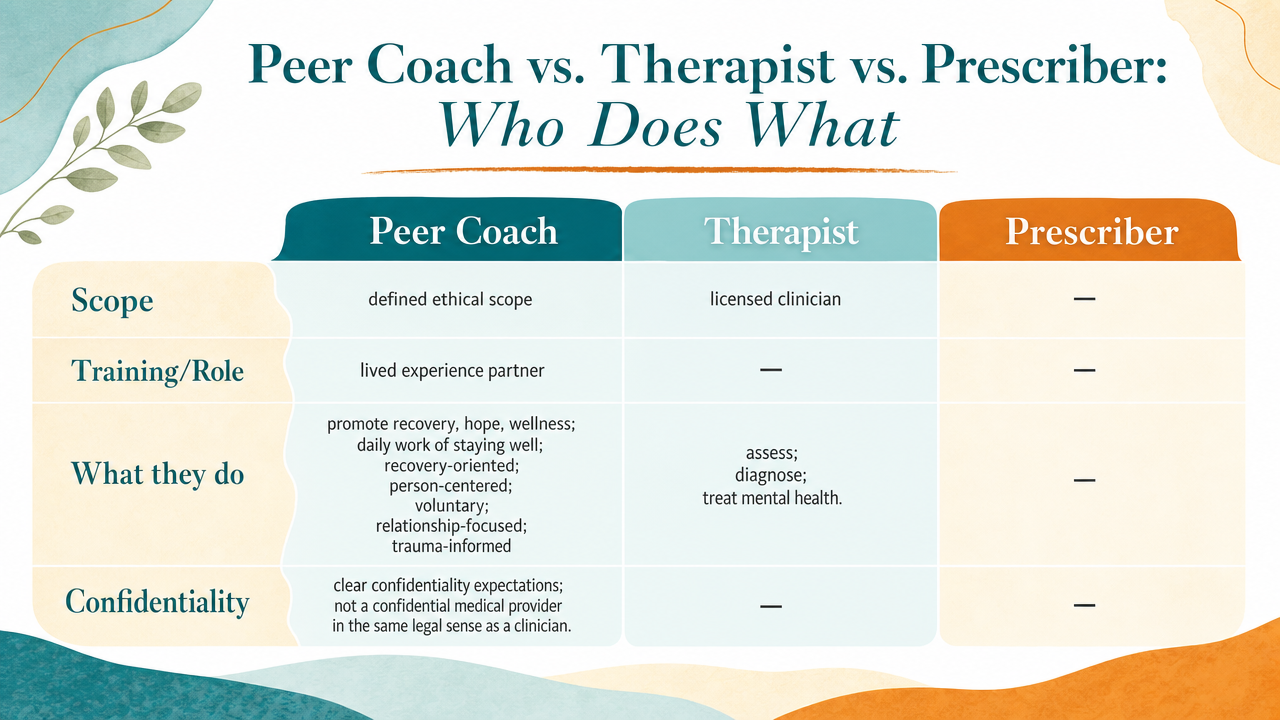
Peer Coach vs. Therapist vs. Prescriber: Who Does What
If you're trying to assemble the right team quietly, the scope question matters more than almost anything else. Getting this wrong is how people end up either under-supported or over-disclosed at work. Here's how the three roles actually sort out.
A peer coach in Connecticut operates inside a defined ethical scope: sharing lived experience to promote recovery, hope, and wellness, and doing so in ways SAMHSA describes as recovery-oriented, person-centered, voluntary, relationship-focused, and trauma-informed5, 11. They are a partner in the daily work of staying well. They are not a confidential medical provider in the same legal sense your clinician is, though their state code of ethics holds them to clear confidentiality expectations.
A therapist is a licensed clinician who can assess, diagnose, and treat mental health and substance use conditions using evidence-based therapies. They write clinical notes, carry malpractice insurance, and operate under their licensing board. If you are working through trauma, co-occurring depression or anxiety alongside SUD, or a pattern you can't yet name, this is the seat for that work.
A prescriber, usually a psychiatrist, addiction medicine physician, or psychiatric nurse practitioner, evaluates whether medication belongs in your plan. For substance use, that often means buprenorphine, naltrexone, or related options. For co-occurring conditions, it might mean an antidepressant or anti-anxiety medication managed alongside your SUD care.
The three roles are not interchangeable, and you don't have to pick one. Many people in sustained recovery use all three at once, with the peer coach functioning as the connective layer that helps the clinical work translate into a livable week.
How Connecticut Credentials Peer Coaches
DMHAS, ORCA, and Recovery University: The State Pipeline
Connecticut doesn't leave peer credentialing to chance, and that's good news for you. Three pieces of state infrastructure work together to define who can call themselves a certified peer in this state, and you can name all three when you're vetting someone.
The Department of Mental Health and Addiction Services (DMHAS) is the parent body. Inside DMHAS, the Office of Recovery Community Affairs (ORCA) handles the peer side specifically. ORCA coordinates the peer certification advisory committee meetings and posts DMHAS-endorsed peer recovery support training, which means it functions as the public-facing hub for what counts as a legitimate peer credential in Connecticut 1. If a coach can't tell you how their training relates to ORCA, that's a flag worth noticing.
DMHAS also maintains a dedicated page describing the formal peer recovery support certification process and points readers back to ORCA for current updates 2. So the path is documented, not informal.
The training itself runs through Recovery University, the DMHAS Office of Workforce Development program that prepares people to become Certified Recovery Support Specialists in peer-delivered services 3. That's the workforce pipeline. When you hear a coach mention RSS training or Recovery University, they're describing a state-run track, not a weekend workshop someone bought online.
The practical takeaway: ORCA defines the standard, Recovery University trains to it, and DMHAS holds the whole thing together.
The CPSRP Transition: Dates That Matter Right Now
Here's where the timing gets specific, and where you'll want to pay attention if you're choosing a coach in the next year.
Connecticut is in the middle of moving its peer workforce onto a refreshed credential called the Certified Peer Support and Recovery Professional, or CPSRP. To bring existing, experienced peers onto the new credential without forcing them to start from scratch, DMHAS opened a grandparenting window. Applications for grandparenting opened October 2, 2025 and close October 1, 2026. The certification is valid for two years, and renewal requires 10 hours of continuing education each year4.
Read those numbers slowly, because each one tells you something useful as a person vetting a coach.
The grandparenting window means a peer who has been doing this work in Connecticut for years has a defined path to carry their experience onto the new credential, but only if they apply before October 1, 2026. After that, the door closes. If your coach is established and still hasn't moved onto CPSRP by late 2026, ask why.
The two-year cycle means a current credential isn't a one-time achievement. It's a status that has to be renewed, which is exactly what you want from someone supporting your recovery long-term.
The 10 continuing education hours per year is a small but meaningful detail. It tells you the state expects peers to keep learning, keep refreshing ethics training, and keep current on recovery practice. A coach who can casually mention what CE they did last year is signaling that they take the credential seriously, not just as a line on a profile.
None of this is about gatekeeping for its own sake. It's about giving you, the person making a careful and private decision, a verifiable set of facts to ask about. You don't have to take anyone's word for their qualifications. You have dates.
How to Verify a Coach's Credential Before Your First Session
You shouldn't have to play detective, but a few quiet questions before a first session will tell you most of what you need to know. None of them are rude. A credentialed peer will expect them.
Start with the direct ask: what credential do you currently hold, and what's its status? You're listening for a specific answer, like CPSRP or Certified Recovery Support Specialist, not a vague reference to being trained in peer support. If they're mid-application during the grandparenting window, that's a fair answer. Ask when they expect the credential to be issued.
Next, ask where they trained. The phrase you want to hear is Recovery University or a DMHAS-endorsed training program. If they trained out of state, ask how that training has been recognized for Connecticut practice.
Then ask about continuing education. Have they completed CE hours this year, and on what topics? Recent CE on ethics, trauma-informed practice, or co-occurring conditions is a strong signal.
Finally, ask who supervises them or, if they're independent, how they handle case consultation. Peers in good practice don't work in isolation.
If any of those questions get a defensive response, that itself is information. A coach who is solid on their credential will answer in a few sentences and move on. That's the tone you're looking for.
The Ethics Standard You Can Hold a Coach To
Credentials tell you someone passed a training. Ethics tell you how they show up on a hard day. In Connecticut, you don't have to guess at the standard, because DMHAS publishes it.
The state's Code of Ethics and Values for peer support and recovery professionals says certified peers will share lived experience stories to promote recovery, hope, and wellness 5. That sentence sounds simple, but it's doing real work. It draws a line around what the role is for. A peer coach isn't there to fix you, manage you, or be your friend in a casual sense. They're there to use their own story, carefully and on purpose, to keep yours moving forward.
For you, that translates into a few things you can actually expect. Person-first language, always. Voluntary engagement, meaning you set the pace and you can end the relationship without justifying it. Boundaries that protect both of you, including how your coach handles disclosures, dual relationships, and confidentiality. And a recovery-oriented posture that doesn't pathologize a hard week or treat a slip as a verdict on your character.
Recovery, Made Possible — From Home
Pathfinder Recovery offers in-home addiction and mental health treatment that fits your life — not the other way around. From at-home detox and MAT to virtual IOP and peer support, our licensed clinicians bring evidence-based care to you through secure telehealth.
After Detox, IOP, or a Slip: The Connective Tissue
The hardest stretch of recovery often isn't the clinical part. It's the Tuesday afternoon two months after detox, when the structure has thinned out and your calendar is full of things that have nothing to do with staying well. That's the gap peer coaching is designed to fill.
SAMHSA puts it plainly: peer workers help reduce the likelihood of relapse and extend support beyond the clinical setting10. Read that carefully. The point isn't to replace your clinician. The point is to keep the work alive in the hours and days when no clinician is in the room.
Connecticut's training pipeline is built to do exactly that. The state's Recovery Support Specialist curriculum covers history and foundations of recovery and peer support, plus values, ethics, and principles, and it lines up cleanly with SAMHSA's five competency descriptors: recovery-oriented, person-centered, voluntary, relationship-focused, and trauma-informed 6, 11. So when your coach checks in after a hard meeting, or sits with you while you draft a boundary you've been avoiding, that work is anchored in a documented framework, not improvised.
If you're coming out of detox or finishing an IOP, a peer coach gives the next phase a heartbeat. If you've had a slip, they help you re-enter care without the spiral of shame that usually delays it by weeks. That's the connective tissue.
When Peer Coaching Is Not Enough on Its Own
A good peer coach will be the first person to tell you when you need more than they can offer. That honesty is part of the role, not a failure of it.
If you're in active withdrawal, peer coaching is not the right starting point. You need a medical evaluation, and possibly supervised detox, before continuing care makes sense. If you're having thoughts of self-harm or suicide, that's a clinical situation that needs a licensed provider and, in a crisis, emergency care, not a coaching call.
Co-occurring conditions deserve the same clarity. If anxiety, depression, PTSD, or another mental health concern is sitting alongside your substance use, a peer coach can support you through it, but the diagnosis and treatment piece belongs to a therapist and, where appropriate, a prescriber. Peer coaching works best as one part of a layered plan, not the whole plan.
None of this is a knock on the role. It's the opposite. A coach who knows their scope is one you can actually trust with yours.
Virtual Peer Coaching for a Working Professional's Schedule
Privacy First: Why Virtual Often Beats In-Person for Discretion
If you've been quietly weighing whether to reach out, the privacy math is probably already running in your head. Who might see your car in the parking lot. Who from your firm volunteers at that community center. Whether the receptionist went to high school with your spouse. Connecticut is a small state, and the recovery community inside it is smaller still.
Virtual peer coaching changes that math in your favor. You don't sit in a waiting room. You don't sign in at a front desk. You don't park anywhere visible. The session happens on a device you already use, from a room you already control. If a colleague pings you at 12:55, you close one window and open another.
That shift matters for the kind of work you do. Licensed professionals, people in client-facing roles, leaders whose teams watch their calendars, people in industries where a disclosed history can rewrite a career arc. The risk isn't paranoia. It's a reasonable read of how information travels.
Virtual delivery also lets you choose a coach based on fit and credentials rather than commute. A CPSRP-credentialed peer two towns over is as accessible as one in your zip code. Your search just got wider, and quieter at the same time.
Fitting Sessions Into a Real Week
Recovery support that requires you to leave the office at 2 p.m. on a Wednesday isn't support you'll keep using. You already know that. The question is whether peer coaching can actually flex around the week you have, not the week a brochure imagines.
Most virtual coaches in Connecticut work in 30 to 60 minute sessions, and many hold early morning, lunch, and evening hours specifically because their caseload is full of people like you. A standing Tuesday 7 a.m. call before the day starts. A 30-minute lunch session in your car or a closed office. A check-in on Thursday night after the kids are down. Travel weeks don't have to break the rhythm, because the session moves with your laptop.
The cadence matters more than the length. A consistent weekly touchpoint with occasional shorter check-ins between sessions does more for sustained recovery than a sporadic 90-minute meeting you cancel half the time. Ask any prospective coach how they handle scheduling around your real calendar. A good one has heard the question before and has an answer ready.
Choosing a Peer Coach in Connecticut: A Quiet Checklist
You don't need a 40-point rubric. You need a short list of questions that tell you quickly whether someone is the right fit, and the discipline to actually ask them before you commit to a standing time on your calendar.
Start with credential and currency. Does the coach hold a CPSRP or Certified Recovery Support Specialist credential, or have an active grandparenting application in motion before the October 1, 2026 deadline 4? A clear, specific answer here tells you they take the state's standard seriously.
Move to training and ethics. Did they come through Recovery University or another DMHAS-endorsed track 3? Can they describe, in their own words, what person-first, recovery-oriented practice looks like on a hard day? A coach who has internalized the state's code of ethics will not stumble on that question 5.
Then check fit. Do they have lived experience with something close enough to your situation that you don't have to over-explain? Do they hold hours that match a real working week, including early mornings or evenings? Do they describe coaching as a partnership rather than a program they're running on you?
Ask how they coordinate with clinicians. If you're already working with a therapist or prescriber, the coach should welcome that, ask how you'd like communication handled, and respect any wall you want to keep up. Coaches who treat clinical providers as competitors are coaches to avoid.
Finally, trust your read on the first call. You're not signing a contract for life. A 20-minute intro conversation will tell you whether their voice lands for you. If it doesn't, that's useful information, not a failure. The right coach exists. Keep looking until the answer is yes.
A Next Step That Respects Your Privacy
Researching this quietly, on your own time, already took something. Acknowledge that. You didn't ask anyone for permission, and you didn't out yourself to do it. That's the version of starting that fits a working life in Connecticut.
When you're ready, the next step is small on purpose. A 20-minute conversation with one credentialed peer. Not a commitment, not a program intake, just a call where you ask the questions in this article and listen for how the answers land. If the fit is right, you'll know. If it isn't, you'll have learned what to ask the next person.
Virtual peer coaching through a provider like Pathfinder Recovery keeps that first step on your terms, on your device, on your schedule. Your name stays your own. Your recovery stays yours.
Frequently Asked Questions
Is peer coaching in Connecticut confidential if my employer requires a clean record?
Peer coaches operate under Connecticut's published Code of Ethics, which sets clear confidentiality expectations for the relationship 5. A peer coach is not a mandated reporter to your employer, and virtual sessions leave no parking lot, no waiting room, no sign-in sheet. Ask any prospective coach directly how they handle records, who can request them, and what would trigger any disclosure. A credentialed coach will have a specific answer ready.
What is the difference between a peer coach and a therapist in Connecticut?
A therapist is a licensed clinician who can assess, diagnose, and treat mental health and substance use conditions. A peer coach uses their own lived recovery experience to support your day-to-day work of staying well 5. Peer coaches don't diagnose or provide psychotherapy. The two roles aren't competitors. Many people in sustained recovery work with both at once, using the coach as the connective layer between clinical sessions.
How do I verify that a Connecticut peer coach is actually credentialed?
Ask three direct questions. What credential do you currently hold, CPSRP or Certified Recovery Support Specialist? Where did you train, ideally through Recovery University or another DMHAS-endorsed program 3? When does your credential renew, and what continuing education have you completed this year? You can also confirm that their training track connects back to the Office of Recovery Community Affairs, which coordinates peer certification in Connecticut 1.
Can I work with a peer coach while I'm still in outpatient treatment or IOP?
Yes, and many people do. Peer coaching is designed to extend support beyond the clinical setting, not replace it 10. A good coach will ask how you'd like communication handled with your therapist or prescriber and respect whatever boundary you set. If a coach treats your clinicians as competition or pushes you to drop clinical care, that's a serious red flag worth walking away from.
Does virtual peer coaching work as well as meeting in person?
For a working professional weighing privacy and schedule, virtual often works better. You can hold a session from a closed office, your car, or a hotel room on a travel week. Connecticut's training curriculum and ethics standards apply regardless of delivery format 6. What matters more than the medium is the cadence, the fit, and whether your coach holds the same recovery-oriented posture session after session.
What does the CPSRP credential transition mean for someone looking for a coach right now?
Connecticut is moving its peer workforce onto the CPSRP credential, with a grandparenting window for experienced peers that closes October 1, 2026 4. For you, that means a current or in-progress CPSRP application is a fair answer when you ask about credentials right now. By late 2026, established Connecticut peers should be on the new credential. Ask where they are in that process, and listen for a specific timeline.
No items found.
[{"@context":"https://schema.org","@type":"BlogPosting","headline":"Peer Coaching in Connecticut: What You Need to Know","description":"Learn how peer coaching in CT is credentialed, the renewal process, and how to choose trained coaches who support recovery alongside clinical care.","publisher":{"@type":"Organization","name":"Pathfinder Recovery"},"mainEntityOfPage":{"@type":"WebPage","@id":"https://www.pathfinder-recovery.com"}},{"@context":"https://schema.org","@type":"MedicalWebPage","headline":"Peer Coaching in Connecticut: What You Need to Know","description":"Learn how peer coaching in CT is credentialed, the renewal process, and how to choose trained coaches who support recovery alongside clinical care.","mainEntityOfPage":{"@type":"WebPage","@id":"https://www.pathfinder-recovery.com"}},{"@context":"https://schema.org","@type":"FAQPage","mainEntity":[{"@type":"Question","name":"Is peer coaching in Connecticut confidential if my employer requires a clean record?","acceptedAnswer":{"@type":"Answer","text":"Peer coaches operate under Connecticut's published Code of Ethics, which sets clear confidentiality expectations for the relationship. A peer coach is not a mandated reporter to your employer, and virtual sessions leave no parking lot, no waiting room, no sign-in sheet. Ask any prospective coach directly how they handle records, who can request them, and what would trigger any disclosure. A credentialed coach will have a specific answer ready."}},{"@type":"Question","name":"What is the difference between a peer coach and a therapist in Connecticut?","acceptedAnswer":{"@type":"Answer","text":"A therapist is a licensed clinician who can assess, diagnose, and treat mental health and substance use conditions. A peer coach uses their own lived recovery experience to support your day-to-day work of staying well. Peer coaches don't diagnose or provide psychotherapy. The two roles aren't competitors. Many people in sustained recovery work with both at once, using the coach as the connective layer between clinical sessions."}},{"@type":"Question","name":"How do I verify that a Connecticut peer coach is actually credentialed?","acceptedAnswer":{"@type":"Answer","text":"Ask three direct questions. What credential do you currently hold, CPSRP or Certified Recovery Support Specialist? Where did you train, ideally through Recovery University or another DMHAS-endorsed program? When does your credential renew, and what continuing education have you completed this year? You can also confirm that their training track connects back to the Office of Recovery Community Affairs, which coordinates peer certification in Connecticut."}},{"@type":"Question","name":"Can I work with a peer coach while I'm still in outpatient treatment or IOP?","acceptedAnswer":{"@type":"Answer","text":"Yes, and many people do. Peer coaching is designed to extend support beyond the clinical setting, not replace it. A good coach will ask how you'd like communication handled with your therapist or prescriber and respect whatever boundary you set. If a coach treats your clinicians as competition or pushes you to drop clinical care, that's a serious red flag worth walking away from."}},{"@type":"Question","name":"Does virtual peer coaching work as well as meeting in person?","acceptedAnswer":{"@type":"Answer","text":"For a working professional weighing privacy and schedule, virtual often works better. You can hold a session from a closed office, your car, or a hotel room on a travel week. Connecticut's training curriculum and ethics standards apply regardless of delivery format. What matters more than the medium is the cadence, the fit, and whether your coach holds the same recovery-oriented posture session after session."}},{"@type":"Question","name":"What does the CPSRP credential transition mean for someone looking for a coach right now?","acceptedAnswer":{"@type":"Answer","text":"Connecticut is moving its peer workforce onto the CPSRP credential, with a grandparenting window for experienced peers that closes October 1, 2026. For you, that means a current or in-progress CPSRP application is a fair answer when you ask about credentials right now. By late 2026, established Connecticut peers should be on the new credential. Ask where they are in that process, and listen for a specific timeline."}}]}]
Pathfinder Recovery offers in-home addiction and mental health treatment that fits your life — not the other way around.From at-home detox and MAT to virtual IOP and peer support, our licensed clinicians bring evidence-based care to you through secure telehealth.
The Pathfinder Recovery App and Smart Ring keep your care team connected to your progress between sessions — monitoring sleep, stress, and recovery milestones in real time.It’s proactive, private, and personalized — so support is always within reach.
Addiction Relapse Prevention Program by Pathfinder Recovery offers virtual treatment that meets you where you are with tools, support, and guidance too.
Pathfinder’s Virtual Outpatient Addiction Program delivers expert online treatment and counseling that meets you wherever you are for lasting recovery.