
Navigating Anxiety in Recovery
Anxiety In Recovery explores how Pathfinder Recovery expands virtual recovery and mental health care access, helping people manage anxiety online today.

November 6, 2025

Written and reviewed by the leadership team at Pathfinder Recovery, including licensed medical and clinical professionals with over 30 years of experience in addiction and mental health care.
You finished the program. Maybe it was detox, then IOP. Maybe a residential stay followed by outpatient. The schedule was full, the clinical team knew your name, and there was always a next appointment on the calendar. Then discharge happened, and the calendar emptied.
That gap between structured treatment and the rest of your life is where most people lose ground. Not because the clinical work failed, but because Tuesday at 4 p.m. used to be group, and now it's just Tuesday at 4 p.m. The skills you built need somewhere to live.
This is the space Certified Recovery Support Workers (CRSWs) in New Hampshire were built to occupy. They are not therapists, and they are not sponsors. They are credentialed peers with lived recovery experience who walk alongside you in the ordinary hours that treatment doesn't reach. SAMHSA's federal guidance is direct about what this layer does: peer support workers help people stay engaged in recovery and reduce the likelihood of relapse.9
New Hampshire has been quietly building the infrastructure for this for years now, through community college pipelines, Medicaid coverage, RCOs, and The Doorway access network. The pieces are there. Most Treatment Veterans just haven't been told how they fit together, or that they are allowed to use all of them at once. The rest of this guide maps that out.
A Certified Recovery Support Worker is someone who has been where you are and then went and earned the paperwork to do this professionally. That second part matters more than people realize.
In New Hampshire, becoming a CRSW is not a weekend workshop. Candidates complete coursework (often through community college programs like the Addiction Recovery Support Worker certificate at Nashua Community College), log 500 hours of paid or volunteer recovery support work, and pass the IC&RC examination before the state board issues the credential. Manchester Community College runs a parallel pipeline designed specifically to get students to the hours and skill set the NH Board requires. So when you sit down with a CRSW, you are working with someone who has translated their own recovery into a trained practice.3
What does that practice actually look like in your week? It looks like a coach who texts you on the morning of a job interview because they remember it is happening. Who meets you for coffee after a court date. Who knows what a craving feels like at 9 p.m. on a Sunday and does not flinch when you describe it. Their job is to help you build recovery capital in the ordinary hours, and to keep you engaged when the structured supports of treatment fall away. You are not being managed. You are being walked with, by someone who has done the walk.9
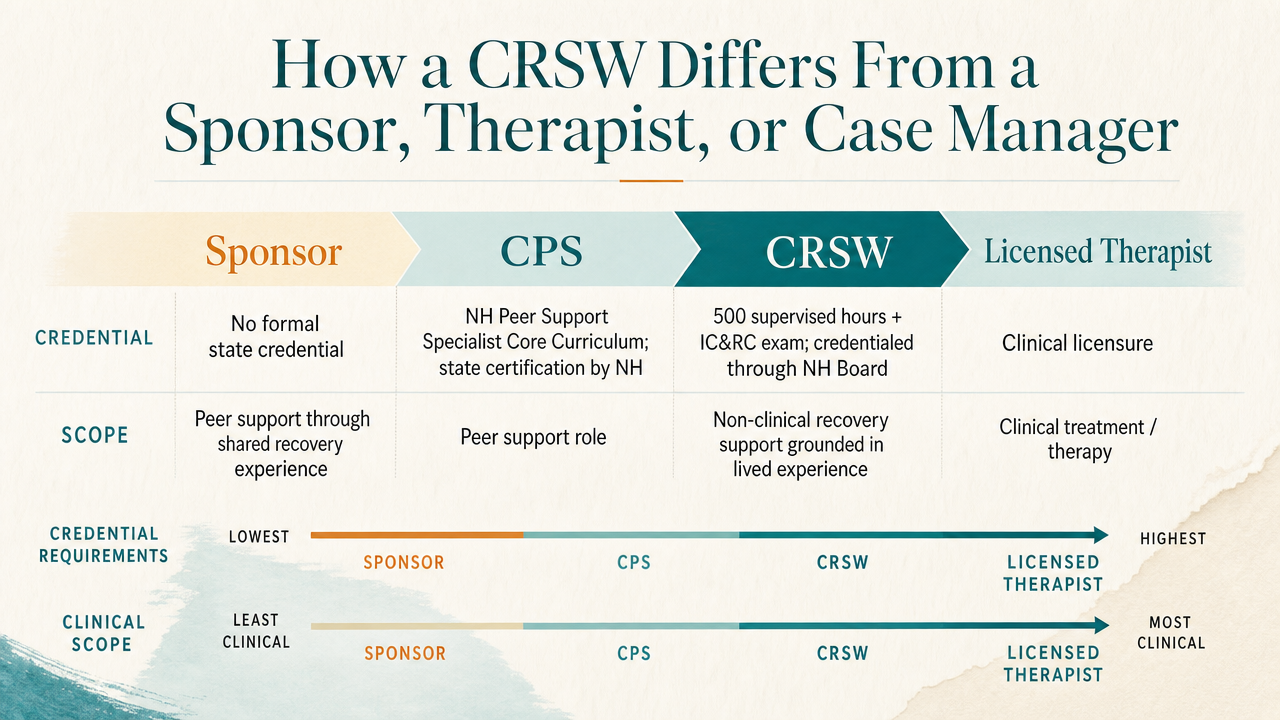
If you have already cycled through treatment, you have probably had a sponsor, a therapist, and maybe a case manager. So the fair question is: what does a peer coach do that none of them do? The honest answer is that each role lives at a different intersection of credential, scope, and relationship. Conflating them is what makes peer coaching feel redundant when it isn't.
Here is the credential ladder, laid out plainly:2,3,8
None of these roles cancels out the others. Your therapist treats the disorder. Your sponsor walks you through a spiritual program if you have one. Your case manager coordinates services. A CRSW does the thing in between, the daily-life translation work, with a credential that makes the role billable, supervised, and accountable. That accountability is the piece a sponsor cannot offer, and the daily-life presence is the piece a therapist cannot offer. You are allowed to have all of them. Most Treatment Veterans who do well long-term, do.2
If peer coaching feels more visible in New Hampshire than it did five years ago, that's because the state has been quietly building the workforce inside its community college system. This is not a side project. It is a deliberate pipeline.
Three colleges, three credentials, one workforce. That matters for you as a Treatment Veteran for a simple reason: when you ask for a peer coach in New Hampshire today, you are far more likely to get someone who came through a structured training path than someone who simply volunteered their way into the role. The training is also currently grant-funded and free to NH students at White Mountains, which keeps the pipeline open in parts of the state where paying tuition would otherwise close the door on this career. The coaches exist because the state built the rooms they could train in.8
Coursework alone does not make a workforce. What turns a certificate into a job is the system standing behind it, and that is what changed in early 2025.
The Community College System of New Hampshire announced a formal collaboration with NH DHHS and Dartmouth Health to train peer support workers to work alongside licensed clinicians supporting people in crisis. Read that sentence again. The state's health agency, its largest academic medical system, and the community college network are all sitting at the same table to produce peer support specialists. That is what institutionalization looks like.10
For you, the practical takeaway is this: the coach you sit across from on a video call is not freelancing their way through your week. They came up through a curriculum the state helped design, a health system helped shape, and a community college delivered. They are trained to work next to your therapist and your prescriber, not in place of them. The role has been built to plug in, which is exactly what aftercare needs.
You already know the clinical continuum: detox stabilizes you, IOP teaches you what to do with the stabilization, outpatient stretches it across months. What the brochure does not usually show is where peer coaching slots in, and that omission is part of why discharge feels like falling off a cliff.
Here is the picture that the NH system actually draws, when you lay all the pieces out:1,11
Peer coaching is not a parallel track to the clinical layer. It is the connective tissue between the clinical layer and the rest of your life. When IOP ends, your therapist may still see you every other week. Your prescriber may check in monthly. The CRSW is the one who can hold the Tuesday and Thursday hours in between, the ones where you used to use, the ones that no one else in your care team is going to occupy.
The DHHS Peer Support Agencies registry is your map for finding the formal version of this in your area. It is one of the few places where you can verify that a program is recognized by the state rather than self-titled. Use it as a starting point, not the whole search.11

If you are reading this as a parent, an older sibling, or a person in recovery whose teenager is now showing the same warning signs you once did, the peer coaching map looks a little different. Adolescents do not respond to the same scaffolding adults do, and New Hampshire has built a separate lane for them.
Alternative Peer Groups (APGs) are structured, community-based programs that combine positive peer connections, substance-free activities, and family involvement for young people facing substance use challenges. They are not a watered-down version of adult peer support. They follow SAMHSA-aligned peer recovery principles and are delivered by professionals trained for youth work, with families looped in as part of the design rather than as observers. Kingswood Youth Center is one of the NH sites running this model.1
For a Treatment Veteran, the value here is two-fold. If your own recovery is stable and you are now watching a younger family member struggle, APGs give you a credible place to point them that is not just an adult AA meeting they will refuse to attend. And if your recovery is still being built, knowing your kid has their own peer infrastructure can lower the pressure on yours. You do not have to be the only adult in the room holding the line.
New Hampshire is a small state on a map and a large state in practice. If you live in Berlin, the nearest recovery community organization with a regular weekday schedule might be an hour and a half south. If you live in Keene, the closest evening peer group could be in Manchester. If you work second shift in a warehouse outside Concord, the meeting that would actually help you is happening while you are still on the clock. Add a January storm, an unreliable car, or a kid who needs a ride home from practice, and the in-person model starts to fail people who genuinely want to use it.
Virtual peer coaching is not a lesser version of the in-person session. For Treatment Veterans in NH, it is often the only version that survives contact with your actual week. A CRSW or CPS specialist can meet you on a video call from your kitchen at 7 a.m. before work, or at 9 p.m. after the kids are asleep. The credential is the same. The supervised hours behind it are the same. The IC&RC exam is the same. What changes is whether the appointment can actually happen.2
There is a second layer here worth naming. Peer support is recognized as a formal part of NH's behavioral health service landscape, with DHHS listing state-recognized agencies publicly. Many of those agencies now deliver hybrid or fully virtual sessions, which means you do not have to choose between credentialed support and a schedule you can keep. You get both. The drive that used to be a reason to skip becomes a reason you showed up.11
The question most Treatment Veterans actually want answered is the one nobody puts on the brochure: can you afford to keep this up after the structured program ends? For peer coaching in New Hampshire, the answer runs through a specific piece of state rule and a federal funding stream that sits behind it.
New Hampshire Medicaid defines a "peer recovery program" under He-W 513.02(t) as a recovery community organization or other entity that provides peer recovery support services for people with substance use disorders. That definition is the hinge. Once a program meets it, Medicaid will reimburse for peer recovery services delivered by trained, credentialed workers, which is what makes a CRSW's hours billable rather than charitable. The state isn't asking RCOs to volunteer this work into existence. It's paying for it inside the same Medicaid envelope that covers your therapist and your prescriber.4
Behind that state rule sits federal grant funding through SAMHSA's Recovery Community Services Program, which underwrites RCOs to deliver peer recovery support services to people with substance use or co-occurring disorders. So the funding stack you actually walk into looks like this: federal grants seed the RCO infrastructure, state Medicaid pays for the sessions, and DHHS publishes the registry of recognized agencies so you can verify a program is real.6,11
One honest caveat. Providers have flagged that Medicaid billing and documentation for peer services can be administratively heavy, which is why UNH and DHHS have run training webinars to help agencies stay compliant. From your side of the call, this rarely shows up as a bill. From the agency side, it shapes who can afford to keep their doors open.4
If you or someone you love is coming out of a correctional facility, the funding picture changed in June 2024, and it matters for how peer coaching can show up at exactly the moment most people fall through the cracks.
CMS approved an extension of New Hampshire's Section 1115 SUD Treatment and Recovery Access demonstration that summer. The piece worth knowing: the state can now offer short-term Medicaid enrollment to people leaving correctional facilities so they can access SUD services at reentry. That means coverage does not start the week you find a primary care doctor. It starts at the gate.7
For peer coaching, that matters in a practical way. The first 30 to 90 days post-release are when overdose risk spikes and structure collapses at the same time. Having Medicaid active means a CRSW can be assigned, billable, and meeting with you on a video call within days of release, not months. The DHHS Peer Support Agencies registry is the same starting point for finding a state-recognized program whether you are coming from IOP or coming home.11
You should not have to time your recovery to the paperwork. The 2024 extension is the state's acknowledgment of that. If reentry is your situation, ask about peer coaching before discharge, not after.
You don't need a referral to start, but you do need a reliable starting point. NH has a few that are worth your time and a few that aren't, and knowing the difference will save you a week of dead-end phone calls.
Start with the DHHS Peer Support Agencies registry. It's the state's published list of recognized agencies and the cleanest way to confirm a program is real before you give anyone your information. Cross-check what you find there against the recovery community organizations operating in your county. If a program is RCO-based, it likely sits inside the federal funding framework that underwrites peer recovery services nationally, which means there is a structure behind the person you'll be working with.6,11
If you are still inside a clinical program, ask your discharge planner or therapist directly:
"Can you connect me with a CRSW before I leave?"
The handoff is smoother when it happens before the calendar empties. If you're reentering from a correctional facility, ask about peer coaching during release planning, not after, because Medicaid coverage can now activate at the gate.7
A few practical filters as you make calls. Ask whether the coach is a CRSW or CPS, and which board issued the credential. Ask whether sessions can be virtual, hybrid, or in person, and how soon you can be matched. Ask what happens if the first coach isn't the right fit, because fit matters more than credentials once you're past the first month. You are allowed to switch. You are allowed to ask twice.
The first session is usually quieter than you expect. No clinical intake form, no diagnostic questions, no one asking you to rate your mood on a scale of one to ten. A CRSW will likely start by telling you a little about their own recovery, then ask what your week actually looks like. Not your treatment history. Your week.
That is the work. Peer coaching is built around the practical hours, so the early sessions tend to map them out: when do you wake up, what is the hardest stretch of the day, who do you live with, what does Friday night look like if nothing is planned. The coach is listening for the gaps the structured program used to fill, and where new scaffolding needs to go.9
By session three or four, you should be doing less talking about recovery and more doing it together. That might mean a coach attending a meeting with you, helping you draft a conversation with your employer, or being on a call at the hour you used to use. If it still feels like a generic check-in by week four, say so. A good CRSW will adjust, or help you find a better match. Fit is part of the credential working.
For questions and peer support on your recovery journey—with real world support that doesn't require you to leave your home—call Pathfinder Recovery today.
A sponsor is a volunteer inside a 12-step fellowship with no credential or governing body. A Certified Recovery Support Worker has completed 500 supervised hours, passed the IC&RC examination, and is credentialed through the New Hampshire Board. That credential makes the work supervised, accountable, and billable. You can have both, and many people in sustained recovery do.2
Yes. NH Medicaid defines a peer recovery program under He-W 513.02(t) as an RCO or other entity providing peer recovery support services for people with substance use disorders, and reimburses for those services when delivered by credentialed workers. Coverage details depend on the agency and your plan, so confirm with the program before your first session.4
Yes, and for many people in the North Country it's the format that actually fits the week. Many state-recognized peer support agencies now offer hybrid or fully virtual sessions, so distance, weather, and work schedules stop being the reason appointments fall apart. The credential and training behind a virtual CRSW are identical to an in-person one.11
Start with the DHHS Peer Support Agencies page, which lists agencies recognized as part of New Hampshire's formal behavioral health service landscape 11. That registry is the cleanest way to confirm a program is real before you share your information. Cross-check what you find there with the recovery community organizations operating in your county, and ask your discharge planner for a warm handoff.
No. Peer coaching is an addition, not a substitute. Your therapist treats the disorder, your prescriber manages medication, and your CRSW or CPS specialist helps you carry the work into daily life and stay engaged in recovery. NH's training partnerships are specifically designed so peer workers sit alongside licensed clinicians, not in place of them.9,10
Yes. Alternative Peer Groups are structured, community-based programs for young people with substance use challenges, built around positive peer connections, substance-free activities, and family involvement. They follow SAMHSA-aligned peer recovery principles, and NH sites such as Kingswood Youth Center deliver this model. If a teen in your family is struggling, an APG is a credible place to start.1
November 6, 2025

May 23, 2025
