
CBT For Addiction: Virtual Treatment that Meets You Where You Are
Explore how CBT for addiction delivered virtually improves craving management, boosts completion rates, and offers personalized, accessible recovery options.

November 7, 2025


Written and reviewed by the leadership team at Pathfinder Recovery, including licensed medical and clinical professionals with over 30 years of experience in addiction and mental health care.
If you are a working professional in Massachusetts thinking about peer coaching, you are probably not asking whether recovery support helps. You already know it does. The real question is quieter: how do you add another layer of care without rearranging your workday, tipping off a colleague, or duplicating what your therapist already covers?
Virtual peer coaching answers that question in a specific way. A peer recovery coach is not a therapist and not a clinician. They are someone with sustained lived recovery experience, trained and credentialed by the state, who works alongside you between clinical appointments — texting through a rough Monday morning, holding a 30-minute check-in from your car before a meeting, walking with you through the messy middle of aftercare 2. Massachusetts formally recognizes this role through the Certified Addiction Recovery Coach (CARC) credential and reimburses it under MassHealth's Peer Recovery Coach benefit 3.
The state's own workforce leans on virtual peer models too. The Betsy Lehman Center runs a confidential Virtual Peer Support Network for health care professionals — proof that Massachusetts already trusts virtual peer conversations to protect the privacy of busy adults who cannot walk into a support center at 2 p.m. on a Tuesday 1.
The sections ahead map how coaching fits with therapy, MAT, and continuing care — and where the boundaries sit.
When you are trusting a stranger with the harder parts of your recovery, you want to know what stands behind the title on their intake form. In Massachusetts, the answer is a specific number of hours — and none of them are optional.
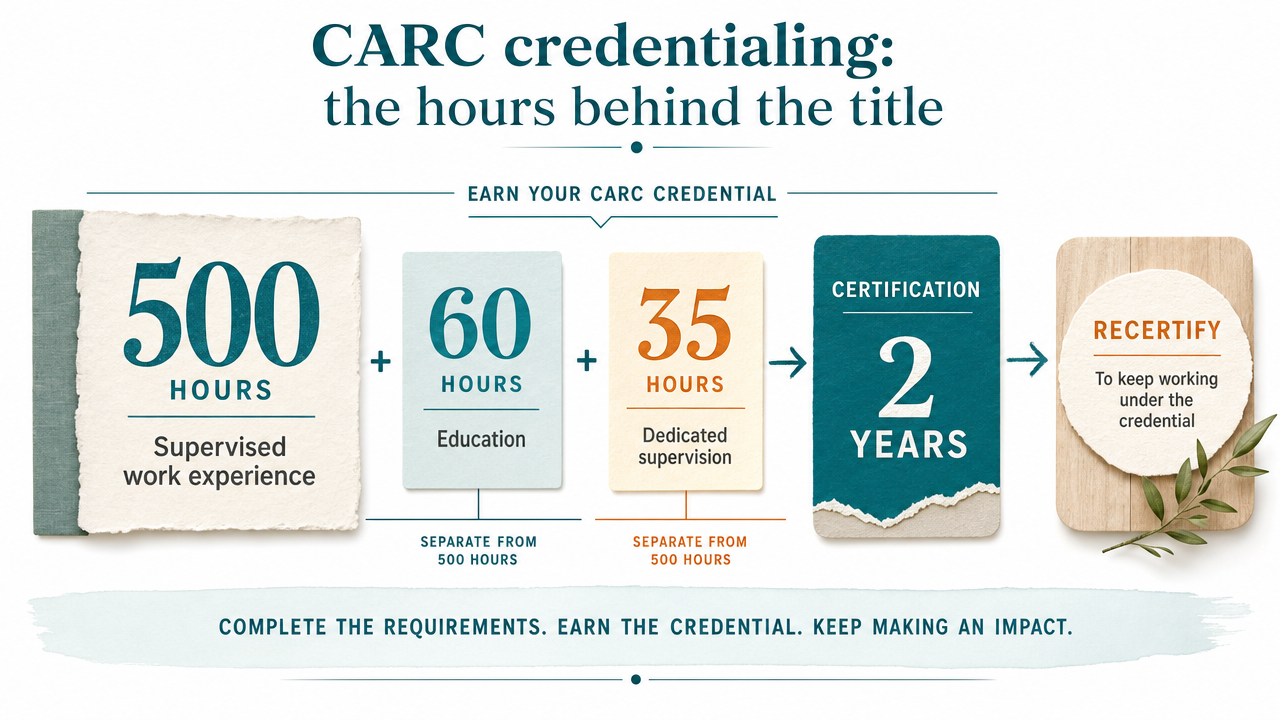
To hold the Certified Addiction Recovery Coach (CARC) credential, a person has to complete 500 hours of supervised work experience, 60 hours of education, and 35 hours of dedicated supervision. Certification lasts two years, at which point the coach has to recertify to keep working under the credential 5.
Read those numbers slowly. Five hundred supervised hours is not a weekend certificate. It is months of doing the work while someone more experienced watches, corrects, and signs off. The 35 supervision hours are separate from that — protected time where a coach brings their harder cases to a supervisor and gets feedback on how they handled a relapse conversation, a boundary question, or a moment they were not sure whether to escalate to a clinician. The 60 education hours cover ethics, boundaries, motivational interviewing basics, and the scope of what coaching is and is not.
The two-year recertification cycle matters too. It means the person on your screen cannot coast on a credential earned years ago. They have to keep learning, keep getting supervised, and keep meeting the state's standard to keep the title. When you ask a prospective coach if they are CARC-credentialed, you are really asking whether they have cleared this bar — and whether they still clear it today.
Here is where peer coaching quietly diverges from every other role in your care plan. Lived recovery experience is not a nice-to-have on a coach's bio. It is a formal job requirement written into Massachusetts Medicaid policy.
The state's approved plan for peer-involved services requires peer recovery coaches to have at least two years of sustained recovery of their own before they can hold or work toward the CARC credential 6. That threshold exists for a reason. A coach who is six months out is still stabilizing. A coach two years in has lived through birthdays, work stress, holidays, and at least one hard week they did not use through — and can speak to yours from the other side of it.
For a working professional, this changes the conversation. Your coach is not a peer in the loose sense of the word. They have sat in a version of your Tuesday. They know what it feels like to open a laptop at 8 a.m. while a craving is still in the room. That is a specific kind of knowing, and Massachusetts treats it as the credential's foundation, not a marketing line.
If MassHealth is your coverage, the mechanics of getting a peer recovery coach paid for are spelled out in one document: Managed Care Entity Bulletin 82. It is worth knowing what it says, because it shapes who you can see, when, and under what approval.
The bulletin does two things that matter to you as a member. First, it locks in the credentialing standard — any coach billing MassHealth for peer recovery services has to hold, or be actively working toward, the Certified Addiction Recovery Coach (CARC) credential or an equivalent EOHHS-approved certification 3. That means the coach across the screen is not a lay volunteer; they are a state-recognized professional whose sessions are billable under a defined benefit.
Second, the bulletin clarifies how prior authorization works. For the first 90 days of peer recovery coach services, managed care entities are expected to allow access without the friction of a prior-approval gate — a rule designed to remove delay at the exact moment ongoing support matters most, right after detox, discharge from an IOP, or a step-down from a higher level of care 3. After that initial window, continued services move under the managed care entity's standard authorization process.
For a working professional, the practical read is simple. If you are transitioning out of an IOP next Thursday and want a coach in place by the following Monday, the 90-day rule is designed to make that possible without a paperwork battle. Ask your MassHealth plan or your discharging clinician to confirm the pathway before your last clinical session ends.
If you carry commercial insurance through an employer, the coverage question is different — and quieter, because there is no single Massachusetts bulletin that governs every carrier. What you do have is the federal Mental Health Parity and Addiction Equity Act, which sets a floor under how plans can treat substance use disorder benefits.
Under MHPAEA, a plan cannot impose more restrictive financial requirements or treatment limitations on mental health and SUD benefits than it applies to comparable medical or surgical benefits 7. In plain terms, your insurer cannot demand a higher copay for recovery-related visits than it would for a routine specialist visit, and it cannot cap the number of SUD-related sessions in a way it would not cap physical therapy or another medical service on the same plan.
What parity does not do is force every plan to cover every service line the same way. Peer recovery coaching specifically may or may not be a named benefit on your commercial plan, and utilization management rules — session limits, medical necessity reviews, referral requirements — can still apply as long as they are comparable to medical-side rules. Before you commit to a coach, call the member services number on your card and ask directly: is peer recovery coaching a covered benefit, and what authorization steps apply?
Reading regulatory language is one thing. Seeing how the three most common payment paths compare, side by side, is another. The table below pulls only from what Bulletin 82 and MHPAEA actually say — no invented dollar figures, no assumed copays.
| Coverage question | MassHealth (Bulletin 82) | Commercial insurance (MHPAEA) | Self-pay |
|---|---|---|---|
| Is peer recovery coaching a defined benefit? | Yes — named benefit with CARC or EOHHS-approved credentialing required 3 | Varies by plan; parity applies to the plan's SUD benefits overall 7 | Not applicable; paid directly to provider |
| Prior authorization for first 90 days | Not required at the front end of the benefit window 3 | Determined by the plan; must be comparable to medical-side rules 7 | None |
| Credential the coach must hold | CARC or EOHHS-approved equivalent, or actively working toward it 3 | Plan-dependent; parity governs limits, not credential lists | Buyer's choice; ask for CARC status directly |
| Where telehealth fits | Recognized within the state's peer-involved service structures | Governed by each plan's telehealth policy under parity | Set between you and the coach |
Two takeaways from the table. If you have MassHealth, the 90-day window is your friend — use it to start without delay. If you are on commercial insurance, the call to member services is the single most important five minutes of your enrollment process. And if you are paying out of pocket for privacy reasons, ask the coach up front about CARC status so the standard of care does not drop just because the payer changed.
One of the fastest ways to lose trust in a care plan is to ask one part of it to do the job of another. So before you build a virtual coach into your week, it helps to see — plainly — where coaching stops and where therapy and medication-assisted treatment (MAT) begin.
A peer recovery coach extends treatment into the parts of your life a clinician never sees: the drive home, the Sunday night before a hard Monday, the moment a coworker mentions drinks after work. That is the role SAMHSA describes when it defines peer workers as people who help you stay engaged in recovery and reduce relapse risk by extending support beyond the clinical setting 2. A coach is not there to diagnose you, prescribe for you, or treat a mental health condition.
| Peer coaching | Clinical therapy | Medication-assisted treatment | |
|---|---|---|---|
| What it does | Extends recovery support into everyday life; check-ins, accountability, lived-experience guidance 2 | Treats mental health conditions, trauma, and co-occurring disorders through evidence-based modalities | Uses FDA-approved medications (buprenorphine, naltrexone) to reduce cravings and stabilize the brain |
| Who delivers it | A CARC-credentialed peer with sustained lived recovery 3 | A licensed therapist, psychologist, or clinical social worker | A prescribing clinician — physician, NP, or PA — with a licensed pharmacy |
| What it is not | Not therapy, not diagnosis, not prescribing | Not lived-experience mentorship; not a substitute for medication when clinically indicated | Not standalone recovery care; works best paired with counseling and support |
Read across that middle row and the boundary becomes practical. If you are working through trauma, adjusting to a co-occurring depression diagnosis, or reworking how you think about a relationship, that is therapy. If cravings are pulling at your day and a clinician determines medication is appropriate, that is MAT. If you need someone who has been through a version of your week and can help you keep the plan intact between those appointments, that is coaching.
Abstract benefit lists are easy. Fitting another appointment into a week that already has back-to-back meetings is harder. So here is what virtual peer coaching can actually look like layered onto a professional calendar — not as a prescription, but as a scene you can picture.
Monday, 7:15 a.m. You text your coach before your first meeting. Rough weekend. A wedding, an open bar, and a longer Sunday than you wanted. Your coach responds within the hour with two sentences and a question: what would make Monday feel steadier by 6 p.m.? No lecture. No script.
Tuesday, 12:30 p.m. Thirty-minute video check-in on your lunch block. Door closed, headphones in. You talk through the wedding, the craving that showed up around the toast, and how you handled it. Your coach names the win out loud — you noticed it before it moved — and asks what you want to bring to your therapist on Thursday.
Wednesday. Nothing scheduled. That is the point. Coaching does not colonize every day.
Thursday, 6:00 p.m. Your therapy session, separate from coaching. You work on the piece your coach flagged: why weddings hit harder than other social events. Different room, different credential, different work.
Friday, 8:45 a.m. A two-minute voice memo from your coach heading into the weekend. Not a check-in — a reminder that Saturday has a plan attached to it.
Sunday, 9:00 p.m. An online support meeting from your kitchen. Camera off if you want.
Total time spent on coaching that week: under an hour. Total time it was there in the background: all seven days. That is what SAMHSA means when it describes peer workers as extending treatment beyond the clinical setting 2— the support does not stop when the video call ends.
For a working professional, privacy is not a preference. It is the condition that makes asking for help possible at all. A virtual peer session removes the parking lot, the waiting room, and the chance of running into a coworker on the way in — and that alone changes what feels safe to say out loud.
Massachusetts already operates on this logic in its own workforce. The Betsy Lehman Center's Virtual Peer Support Network was built specifically so health care professionals — people whose careers depend on discretion — could talk with a trained peer confidentially, from wherever they happen to be 1. The state chose a virtual model for that population for the same reasons you might: schedules that do not bend, reputations that carry weight, and the very human need to be honest with someone who is not going to see you at Monday's team meeting.
Practical discretion looks like a few small things done consistently. Sessions happen on a HIPAA-compliant platform, not a consumer video app. Your coach uses a private space on their end, the way you use one on yours. Calendar invites carry a neutral title rather than a clinical label. If you want a check-in from your car between meetings, that is a legitimate session — coaching is designed to meet you where the day actually is, not where a clinic schedule wishes it were.
Virtual is the whole point when your calendar cannot bend. But there are weeks when a room full of people who get it is exactly what you need — and Massachusetts already has that room, in most parts of the state.
The Bureau of Substance Addiction Services funds a network of Peer Recovery Support Centers (PRSCs) across the Commonwealth, from Greater Boston through the Cape, Worcester, the Berkshires, and the North Shore 4. Many of these centers now run hybrid schedules — in-person groups on site, plus Zoom links for members who cannot make it in that day 4. That flexibility is quiet but useful: your virtual coach handles the week, and a PRSC handles the Saturday morning you actually want to be in a room.
A workable pairing looks like this. Your CARC-credentialed coach stays the through-line — one-to-one, on your schedule, private. A PRSC becomes the optional add-on: an all-recovery meeting when you want community, a peer-led workshop when a specific topic hits close, an in-person anchor for a holiday week. Ask your coach to help you pick which PRSC fits, and let each layer do what it does best.
You are not going to find a headline number that says peer coaching cuts relapse by some tidy percentage. The honest read of the research is more careful than that — and more useful, once you know what to do with it.
A 2025 systematic review of peer recovery support services for substance use disorder pulled together the studies done so far and looked at how the model performs across settings 10. The pattern that emerges is one of engagement and continuity. Peer services help people stay connected to care, show up for what comes next, and keep the plan intact through the stretches when clinical contact is thinner. That lines up with how SAMHSA describes the role at a national level: peer workers help people stay engaged in recovery and reduce the likelihood of relapse by extending support past the clinic walls 2.
What the review does not do is claim coaching replaces therapy or medication. The evidence supports it as a layer — one that works with the rest of your care, not around it. For a working professional, that framing matters. You are not choosing between coaching and clinical treatment. You are deciding whether to add the layer the research keeps pointing to.
By the time you are ready to pick a coach, you have already done the hard part. You know what you need help with, and you know what you do not want another appointment to become. The interview questions below are the ones that actually filter for a coach who can meet you where your week is.
Ask about the credential, not just the label. Are they CARC-credentialed, or actively working toward it under the EOHHS-approved pathway 3? When did they last recertify? A coach who answers cleanly has nothing to hide.
Ask about their recovery, on their terms. Massachusetts requires at least two years of sustained recovery for peer coaches 6, but you are listening for something else too — whether they talk about it as a working part of their life or a talking point on a resume.
Ask how they hold the line with clinical care. A good coach will tell you, unprompted, what they will send back to your therapist or prescriber. If they hedge, that is your answer.
Ask about between-session contact. Text windows, voice memos, response times. This is where coaching earns its keep for a working schedule.
Ask about privacy on their end. HIPAA-compliant platform, private room, neutral calendar language. Small details, big difference.
Pathfinder Recovery is one place to start that conversation if virtual aftercare is where you are heading next.
Yes. MassHealth defines peer recovery coaching as a named benefit through Managed Care Entity Bulletin 82, and the coach must hold or be actively working toward the CARC credential or an EOHHS-approved equivalent 3. Telehealth delivery falls under each managed care entity's policy, so confirm with your specific plan how virtual sessions are billed.
A therapist is a licensed clinician who diagnoses and treats mental health conditions. A peer recovery coach is a credentialed non-clinician with sustained lived recovery experience who supports you between clinical appointments — accountability, check-ins, and real-world guidance. SAMHSA describes peer workers as extending treatment beyond the clinical setting 2. Coaches do not diagnose, prescribe, or replace therapy.
Look for the Certified Addiction Recovery Coach (CARC) credential or documented progress toward it under an EOHHS-approved pathway 3. A coach billing MassHealth must meet this bar. Ask when they last recertified, since the credential runs on a two-year cycle. If you are paying out of pocket, hold the same standard — the credential travels with the coach, not the payer.
Yes, and that is often where coaching earns its keep. A coach works alongside your prescriber and therapist, not around them. If you are stepping down from an IOP, the first 90 days of MassHealth peer recovery coach services are designed to start without a prior-authorization gate, so the support is in place as clinical contact tapers 3.
Sessions run on HIPAA-compliant platforms with private settings on both ends. Massachusetts already uses a confidential virtual peer model for health care professionals through the Betsy Lehman Center's network, which was built for adults whose careers depend on discretion 1. Calendar invites can carry neutral titles, and short check-ins from a car or closed office count as legitimate sessions.
Not identically, but parity applies. Under the federal Mental Health Parity and Addiction Equity Act, plans cannot impose more restrictive financial requirements or treatment limits on SUD benefits than on comparable medical or surgical benefits 7. Whether peer coaching is a named benefit on your specific plan varies, so call member services and ask about coverage, session limits, and authorization steps.
November 7, 2025

November 6, 2025

November 6, 2025