
Virtual Holistic Addiction Treatment Options in NH
Explore how holistic addiction treatment virtual NH programs combine therapy, MAT, and peer support to improve access and recovery outcomes.

May 4, 2026

Written and reviewed by the leadership team at Pathfinder Recovery, including licensed medical and clinical professionals with over 30 years of experience in addiction and mental health care.
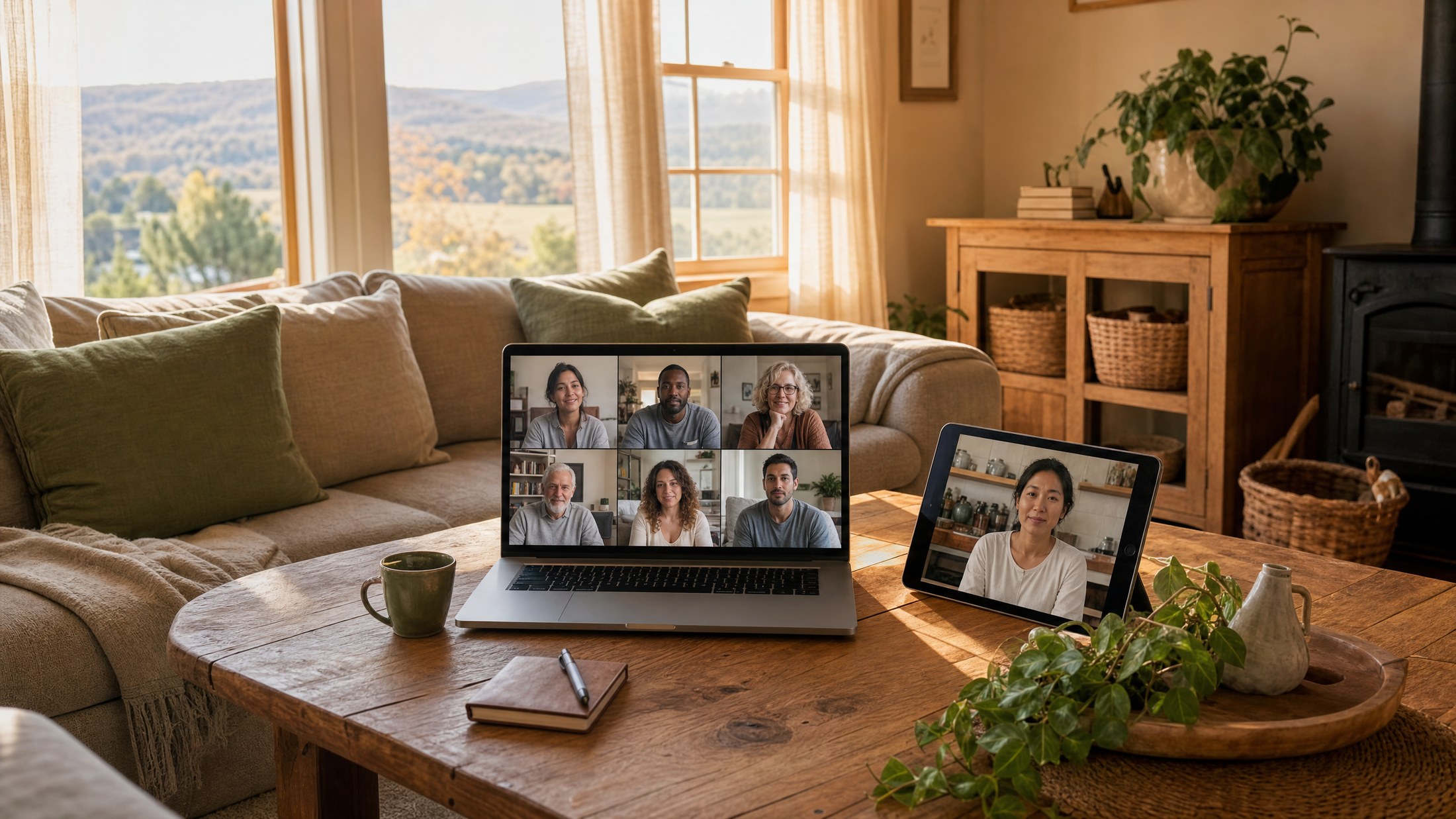
Picture a Tuesday. You finish a 7:30 a.m. status call, close your laptop's other tabs, and join a 90-minute group from the same chair. By 9:45 you're back in your inbox. No drive to Burlington or White River Junction. No badge swipe missed. No parking lot conversation with a coworker who recognized your car.
That's the working-week version of virtual group therapy in Vermont. Most programs serving people in recovery now run cohorts at the edges of the day: early morning before standups, a 12:00 lunch block, and evening sessions starting around 5:30 or 6:00. Camera-off is usually fine for part or all of a session, especially during your first few weeks. Display names can be a first name and last initial. Many platforms work from a phone if you're traveling between Montpelier and a client site in Lebanon.
What stays the same is the clinical work. You show up to the same cohort each week, with the same facilitator and the same six to ten peers. You talk about cravings, sleep, the meeting you almost rescheduled to drink through. The format changed. The therapy didn't.
The rest of this guide walks through what's actually offered across Vermont, what the research says about whether it works, and how to pick a group that fits the life you've built.
Five years ago, joining a recovery group from your kitchen would have felt like a workaround. Today it's a documented part of how substance use care is delivered in the United States.
The shift shows up clearly in federal data. Between 2019 and 2020, the share of U.S. substance use treatment facilities offering telemedicine services more than doubled, climbing from 27.5% to 58.6% in a single year. That jump captures the pandemic catalyst, but it also reflects something that didn't reverse when offices reopened: programs found that virtual delivery worked for the kinds of services that depend on regular, sustained contact, and group counseling is high on that list.1
Federal Medicaid guidance followed. A 2020 CMS bulletin laid out that state Medicaid programs have broad flexibility to cover telehealth for SUD services, including group therapy delivered by live video, and encouraged states to keep those options in place beyond the public health emergency. SAMHSA's evidence-based resource guide for serious mental illness and SUD treatment now treats telehealth as a standard delivery channel, not a substitute of last resort, and points to research showing comparable outcomes to in-person care for many adults.2,3
For you, the practical result is that virtual group therapy in Vermont isn't an experimental side door. It's a recognized, reimbursable format that providers, regulators, and payers have built infrastructure around. The next question is whether it actually helps people stay in treatment and get better. That's what the evidence section takes on.
If you're weighing whether a virtual cohort will hold you the way an in-person room would, the closest answer the research gives is: for most adults in SUD treatment, yes.
A 2022 synthesis prepared for state Medicaid programs reviewed eight controlled studies that directly compared telehealth and in-person SUD treatment in adult populations. Seven of those eight studies found telehealth to be as effective as in-person care across three outcomes that matter for recovery: how long people stayed in treatment, the strength of the therapeutic alliance with the clinician, and substance use itself. Not better. Not worse. Comparable.4
That's a narrower claim than "telehealth works," and the scope is worth holding onto. These were adult SUD studies, not adolescent treatment, not severe psychotic disorders, not acute withdrawal. They measured the kinds of outpatient counseling encounters that make up the bulk of virtual group offerings in Vermont. The findings don't promise that every group will feel the same as an in-person room. They do tell you that the format isn't asking you to trade your outcomes for your schedule.
For a person logging in from a home office between meetings, that parity is the headline. The convenience is real, and the clinical bar is the same one in-person programs are held to.
The parity finding above looks at telehealth broadly. A 2025 peer-reviewed evaluation zoomed in on the format you're actually considering: group therapy for substance use disorder delivered through a hybrid virtual model, where some sessions happen on video and some in person.
Two outcomes drove the analysis. The first was quality of life, which captures the parts of recovery that don't show up on a urine screen: sleep, relationships, work functioning, the feeling that your days belong to you again. The second was treatment completion, meaning the share of participants who finished the program they started. On both measures, the hybrid virtual groups produced results comparable to traditional in-person group models.5
That's the study that speaks most directly to what you'll experience. It's not asking whether telehealth visits work for medication checks. It's asking whether a group can do the work of a group when some or all of the room is on screens, and the answer it returns is that the group can.
The authors do flag implementation friction, technology hiccups, the work of building cohesion across a video grid. None of those are dealbreakers, but they're real, and the next subsection takes them seriously.
An honest read of the evidence includes a soft spot. SAMHSA's evidence-based resource guide notes that even when telehealth produces comparable symptom and substance use outcomes, some studies show a slightly weaker therapeutic alliance, the working bond between you and your clinician or your group, compared with in-person care.3
The gap is small, and it doesn't appear in every study. But it's the kind of detail worth knowing before your first session, because it points to where you have leverage. Alliance grows through the small things: turning your camera on for a few minutes at the start, staying for the unstructured check-in at the end, sending the facilitator a note when something landed hard. None of that is required. All of it tilts the odds.
If the first group doesn't click after three or four sessions, that's data, not failure. Ask about switching cohorts or facilitators. The format isn't the problem to solve.
Process groups are the unstructured-looking ones, and they do more clinical work than the format suggests. There's no worksheet. The facilitator opens with a check-in, and the cohort talks about what's actually going on: the family dinner that triggered a craving, the promotion that came with new travel, the shame loop that started Sunday night.
What you're building is the muscle of saying hard things out loud and hearing other people do the same. For a working professional who spends the day editing what comes out of their mouth, that practice matters. The group becomes a place where you don't have to manage your image.
In a virtual room, process groups work best when the cohort stays small, usually six to eight, and stable across weeks. Familiarity does most of the work.
Skills groups have a curriculum. Cognitive behavioral therapy (CBT) groups walk you through how thoughts, feelings, and behaviors loop into use, then teach you to interrupt the loop. Dialectical behavior therapy (DBT) groups focus on distress tolerance, emotion regulation, mindfulness, and interpersonal effectiveness, the kit you reach for when a Wednesday at 4 p.m. is falling apart.
These translate well to video. You can see the slide, take notes on your laptop, and try a skill between sessions with a colleague or a partner. Many programs send the week's handout ahead so you can follow along even on a phone.
If you came up through a higher level of care and felt like skills sessions were the part that stuck, ask whether your outpatient group is CBT- or DBT-based. The labels matter.
Relapse prevention groups are built around one question: what are your triggers, and what's your plan when you meet them? The work is concrete. You map the people, places, times, and emotional states that historically preceded use, then build specific countermoves for each.
For someone with a travel-heavy job, that might mean writing down what you'll do in a hotel room on the second night of a conference. For someone working from home, it might mean a rule about what happens between 5:30 and 7:00 on Fridays.
Virtual groups are a natural fit here because the planning happens in the environment where you'll actually use it.
If you're on medication-assisted treatment with buprenorphine, naltrexone, or another medication, a MAT support group is the cohort where that part of your recovery isn't a sidebar. Everyone in the room is also taking a medication. Conversations move past whether MAT counts as recovery and into the practical territory: side effects in the first month, what to tell a new primary care doctor, how to handle a dental procedure.
These groups pair well with virtual psychiatry visits for medication management, and the scheduling tends to be flexible because the cohort is built around a shared clinical pathway rather than a calendar block.
Plenty of people in recovery are also working on anxiety, depression, trauma, or ADHD. Co-occurring groups treat those threads together instead of asking you to split your attention across two unrelated treatment plans.
The framing matters because the two often drive each other. A panic spike at 11 p.m. is also a relapse risk. An untreated depressive episode pulls people out of outpatient care. Groups that hold both in view tend to ask different questions: not just "what did you use this week," but "what was your sleep like, and when did the urge show up?"
These groups are typically run by clinicians trained in both areas and pair with individual therapy and, when appropriate, psychiatric medication management. They're built for integration, not for treating the mental health piece as primary care on its own.
Group therapy isn't a level of care on its own. It's a building block that shows up at every level, and the level you need depends on how much structure your week can absorb.
The Vermont Department of Health's Division of Substance Use Programs (DSU) organizes care along a continuum that stretches from prevention and harm reduction through outpatient treatment, intensive outpatient programs, partial hospitalization, and residential settings, with recovery supports running alongside. Group is woven through most of it. What changes is the dose.8
Standard outpatient is the lightest touch. You might attend one group a week, sometimes paired with an individual session. This is where many working professionals land after a step-down, or where they start if their use hasn't pulled them away from daily functioning. The schedule is built around your job, not the other way around.
Virtual intensive outpatient (IOP) raises the intensity. Expect three groups a week, often nine to twelve clinical hours total, plus individual therapy and case management. IOP is where the bulk of structured group work happens for people who need real treatment hours without leaving home or stepping out of work. Cohorts meet on a fixed weekly schedule, and the group is the spine of the program.
Partial hospitalization (PHP) goes higher still, with most weekdays committed to clinical time. It's the closest thing to residential without the bed. Group therapy at this level is daily, and the cohort sees each other often enough that the room develops a memory.
DSU certifies the providers operating across these levels and supports the preferred provider network that keeps the continuum coherent statewide. Knowing where you fit, and where you're stepping down to next, is half the work of choosing a group.8
If you're considering a virtual program with clinicians based outside Vermont, there's a specific rule worth knowing about. Vermont's telehealth statute, Title 26 Chapter 56, creates two pathways for out-of-state health care professionals to treat people living in Vermont: a telehealth license and a telehealth registration. Both are real, both are used, and both carry a cap.
Under the telehealth license pathway, an out-of-state clinician can provide telehealth services to no more than 20 unique Vermont patients during the two-year license term. That's not 20 sessions. That's 20 people, total, across two years.6
The practical effect for you is that the clinician running your virtual group should either be licensed in Vermont or operating under one of these telehealth pathways with capacity to take you on. Programs serving Vermonters at any scale typically staff with Vermont-licensed clinicians for that reason. When you're vetting a program, it's a fair question to ask: where is my group facilitator licensed, and under what authority are they treating Vermont residents?
A good intake coordinator will answer that without hesitation. If the answer is vague, keep asking.
Vermont doesn't leave substance use treatment quality to the open market. The Division of Substance Use Programs (DSU) certifies treatment providers that participate in the state's approved and preferred provider system, and that certification sets expectations for clinical standards, staffing, and compliance.9
For you, certification status is a useful shorthand. A DSU-certified provider has been vetted against state criteria for delivering SUD care, and the preferred provider designation signals integration with Vermont's broader system of care. That integration matters when you're moving between levels, say, stepping down from IOP to standard outpatient, or coordinating with a primary care doctor who prescribes your MAT medication.8
Not every program serving Vermont residents is DSU-certified, especially smaller telehealth-only operators. That doesn't automatically disqualify them. It does mean you should ask how they coordinate care with Vermont-based providers and whether they accept the same insurance plans the certified network does.
The coverage news is mostly good. CMS guidance to state Medicaid programs confirms broad flexibility to cover telehealth for SUD services, including group therapy delivered by live video, and Vermont Medicaid has built that flexibility into its behavioral health benefits. If you're a Medicaid member, virtual group therapy for substance use is generally a covered service when it's medically necessary and delivered by an enrolled provider.2
Commercial coverage varies plan by plan, but Vermont's parity environment and the post-2020 normalization of telehealth mean most commercial insurers reimburse virtual group counseling on terms similar to in-person sessions. Before you commit, two questions are worth asking your prospective program: which plans do you accept in-network, and do you verify benefits before the first session?
If you're between jobs or carrying a high deductible, ask about sliding-scale options or self-pay rates. Many DSU-aligned providers can route you toward a coverage path that doesn't require you to front the full cost.
The question most working professionals ask before their first session isn't whether the therapy works. It's whether anyone will know they're there.
Here's what you actually control. Your display name can be a first name, initials, or a name you choose at intake. Your camera is yours to turn on or off, and during early sessions most facilitators expect that some squares stay dark. Your location stays private to you, the cohort only sees the small frame you choose to show, which is why people log in from a closed office, a parked car, or a bedroom with the door shut. Chat messages route through the platform, not your personal accounts. You're never asked to share a phone number or workplace with the group.
The clinical side is bound by HIPAA. The program runs on a platform with a signed business associate agreement, sessions aren't recorded without explicit consent, and what other members say in the room is protected by group confidentiality norms the facilitator establishes in week one. Other participants aren't covered by HIPAA the way the clinician is, which is why every group opens with the same agreement: what's said here stays here.
Discretion isn't a feature you have to ask for. It's the default. You decide how much of yourself to bring into the frame, and you can change that decision week to week as trust builds.
The best group for you is the one you'll actually log into next Tuesday. That sounds obvious until you're staring at three program options at midnight, trying to decide.
Start with the schedule. If your calendar can't reliably hold three weekday clinical blocks, a standard outpatient group is the honest answer for now. If you have the room and the clinical need, virtual IOP gives you the dose that actually moves things. Don't pick the lighter option to protect your job and then quietly relapse around month two. Don't pick the heavier one because it feels more serious and burn out by week three.
Then match the group's clinical function to what you're working on. Coming off a residential stay with shaky skills? A CBT or DBT skills group earns its place on your calendar. Stable on MAT but isolated? A medication-specific cohort puts you with people speaking your language. Mental health threads tangled with the substance use? A co-occurring group treats both at once instead of asking you to schedule two parallel treatments.
Ask three questions of any program before you commit:
The answers tell you most of what you need to know.
For online support along the way—from a multidisciplinary team who has walked the path to recovery themselves—connect with Pathfinder Recovery today.
For most adults in outpatient SUD treatment, yes. A 2025 peer-reviewed evaluation of hybrid virtual group models found quality-of-life improvements and treatment completion rates comparable to traditional in-person group programs. The format isn't asking you to trade outcomes for flexibility. It's asking you to show up to the cohort, week after week, the same way an in-person room would.5
Yes, especially in your first few sessions. Most facilitators expect that some squares stay dark while trust builds, and your display name can be a first name or initials. Turning the camera on later, even for a few minutes during check-in, tends to strengthen the working bond with the group, which is one place telehealth can score slightly lower than in-person care.3
Generally, yes. CMS guidance gives state Medicaid programs broad flexibility to cover telehealth for substance use disorder services, including group therapy delivered by live video, when provided by an enrolled provider and medically necessary. Vermont Medicaid has built that flexibility into its behavioral health benefits. Ask any program you're considering to verify your specific benefits before the first session so there are no surprises.2
They can, under Vermont's telehealth license or telehealth registration pathways, but with limits. A telehealth license caps an out-of-state clinician at 20 unique Vermont patients during the two-year term. Programs serving Vermonters at any scale typically staff with Vermont-licensed clinicians instead. It's a fair intake question: where is my facilitator licensed, and under what authority are they treating Vermont residents?6
Most Vermont virtual programs run cohorts at the edges of the workday: early morning before standups, a noon block, and evening sessions starting around 5:30 or 6:00. Camera-off is usually fine when you need it, and many platforms work from a phone if you're traveling. Pick a schedule you can hold for the next three months, not the one that looks most ambitious this week.
Group therapy is a building block. Virtual IOP and PHP are levels of care that use group as their spine. Standard outpatient might mean one group a week. Virtual IOP typically runs three groups weekly, nine to twelve clinical hours, plus individual therapy. PHP commits most weekdays to clinical time. The format is the same video room; the dose is what changes based on what your week and your recovery need.
May 4, 2026

November 6, 2025

May 1, 2025