
Supporting Your Loved One Without Burnout and Compassion Fatigue
Burnout and Compassion Fatigue care from Pathfinder Recovery offers virtual support that breaks barriers, helping professionals heal and rebuild balance from home.

November 6, 2025


Written and reviewed by the leadership team at Pathfinder Recovery, including licensed medical and clinical professionals with over 30 years of experience in addiction and mental health care.
You already know what residential treatment would cost you. Not the bill — the visibility. A month off the calendar. Questions from your team. A gap you'd have to explain. That math is part of why you've been quietly searching instead of calling anyone.
Here's what's changed in Massachusetts: virtual substance use disorder care is not a pandemic holdover or a softer version of the real thing. It's a state-regulated standard of care that lives inside the same clinical framework as in-person treatment. MassHealth has formally covered telehealth-delivered behavioral health and outpatient SUD services since January 1, 2019, through All Provider Bulletin 281, which set HIPAA-compliant technology requirements and named the specific services that can be delivered remotely 9. That coverage isn't a workaround. It's a policy.
For you, that means a workweek can hold treatment without breaking. A 25-minute medication management visit with a prescriber. A virtual intensive outpatient block in the evening. A counseling session at 7:30 a.m. before your first meeting. Federal guidance from HHS recognizes telehealth as an appropriate way to deliver medication-assisted treatment combined with counseling when programs follow evidence-based protocols 8. Peer-reviewed work on telehealth-delivered MAT for opioid use disorder shows that adding medication to psychosocial care reduces opioid use, overdoses, relapses, and infectious disease incidence while improving retention 4.
The rest of this guide walks through what's actually available to you in Massachusetts — the rules behind it, the clinical services you can use from a closed door at home, how to start without an in-person intake, and where a virtual provider like Pathfinder Recovery fits among the state's regulated options. You don't have to disappear from your life to get care. That's the part worth knowing first.
If you grew up assuming telehealth was an emergency invention from 2020, the Massachusetts timeline will surprise you. The state's Medicaid program put behavioral health telehealth into formal coverage on January 1, 2019 — a full year before any pandemic forced anyone's hand. That happened through MassHealth All Provider Bulletin 281, which spelled out which provider types could deliver covered services remotely and which services qualified 9.
The bulletin is specific in ways that matter to you. It names community health centers, community mental health centers, and outpatient SUD providers as the provider types that may deliver covered services via telehealth. It identifies the actual services on the menu — opioid treatment counseling and ambulatory outpatient counseling among them — and requires that those sessions run on HIPAA-compliant telehealth technology 9. That last detail is why a legitimate MA virtual program will not see you over a casual video call. The platform itself is part of the regulation.
A 2022 state audit of MassHealth's telehealth oversight reinforces the same starting point, treating Bulletin 281 as the moment behavioral health telehealth became a covered, monitored part of the program rather than a side experiment 10. Translation for your situation: when you ask whether your insurance can pay for a virtual SUD counseling session in Massachusetts, the answer for MassHealth members has been yes, on paper, for years.
Coverage is one question. Quality oversight is another. In Massachusetts, the Bureau of Substance Addiction Services (BSAS) sits at the center of that second question. BSAS oversees the statewide system of prevention, intervention, treatment, and recovery support services, and it's responsible for licensing SUD treatment programs and the counselors who work in them 11. When you compare two virtual programs serving Massachusetts residents, BSAS licensing is one of the cleanest filters you have.
Behind BSAS sits a broader legal framework — statutes, regulations, and case law that govern SUD care in the state, including patient rights and the rules programs have to follow whether they meet you in an office or on a screen 7. You don't need to read the regulations yourself. You just need to know they exist, and that the program you're considering operates inside them.
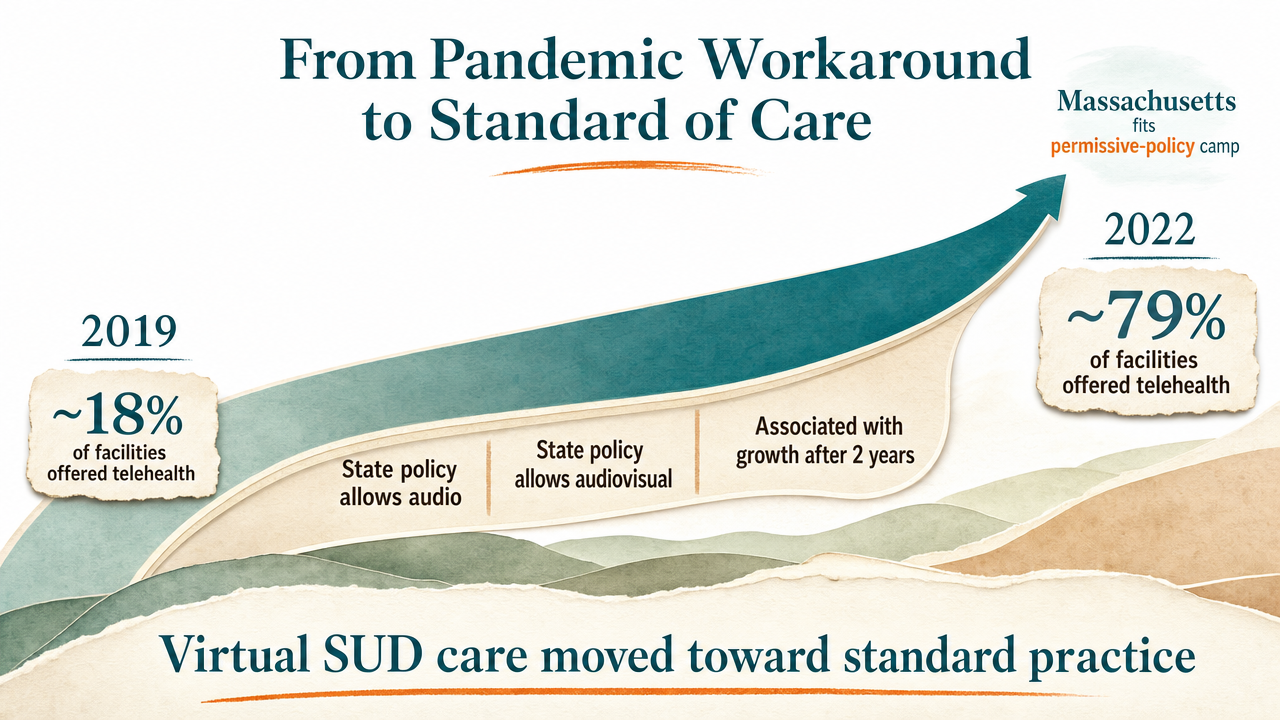
The shift from "telehealth as backup" to "telehealth as standard" isn't a feeling. It's measurable. A 2023 peer-reviewed study looking at U.S. SUD treatment facilities found that the share of facilities offering telehealth services jumped from roughly 18% in 2019 to about 79% in 2022 — and that state policies allowing audio and audiovisual telehealth modalities were associated with that growth two years after enactment 6. That's a national study about facility adoption, not a Massachusetts-only figure, but Massachusetts sits squarely in the permissive-policy camp the study describes.
What that means for you, sitting in Boston or Worcester or Pittsfield with a calendar full of meetings: you are not asking a fringe question when you ask about virtual SUD care. You are asking about the format the field has moved toward. The clinical infrastructure caught up to the demand.
HHS guidance backs the same direction at the federal level, recognizing telehealth as an appropriate channel for medication-assisted treatment combined with counseling when programs follow evidence-based protocols 8. So when you put MassHealth's 2019 coverage shift, BSAS's licensing oversight, and the national adoption curve side by side, you get a clear picture. Online SUD treatment in Massachusetts isn't an experiment you're being asked to trust. It's a regulated category with a track record. You're choosing a provider inside it, not deciding whether the category is real.
Let's start with the part that does the heaviest clinical lifting: medication. If you're dealing with opioid use, the medications that change outcomes are buprenorphine (often dispensed as Suboxone) and naltrexone. They are not a side feature of treatment. They are the foundation that counseling is built on.
The peer-reviewed evidence is direct. Compared with psychosocial treatment alone, adding medication-assisted treatment:
Higher retention matters more than it sounds. Staying in treatment is the variable that most predicts whether the rest of recovery has time to take hold.
Federal guidance from HHS treats telehealth as an appropriate channel for MAT when it's paired with behavioral counseling and delivered under evidence-based protocols 8. That pairing is the standard — medication plus therapy, not medication alone. The same review that documents MAT's clinical benefits notes that head-to-head studies comparing telehealth MAT to in-person MAT are still limited, so the honest version of the claim is this: the medication itself has strong evidence, and telehealth is a recognized way to deliver it 4.
What that looks like on your calendar is smaller than you might expect. An induction visit with a prescriber to start buprenorphine. Follow-up medication management visits that usually run 20 to 30 minutes. Counseling sessions scheduled separately. Prescriptions sent to a pharmacy near you. No in-person clinic visit required to initiate care in most cases, and no waiting room.
The continuum a Massachusetts resident can actually use from home stretches further than MAT alone:
Each piece of that stack has a clinical role. None of it requires you to disappear from your life to start.
Intensive outpatient programs used to mean leaving the office at 4 p.m. three days a week and hoping no one asked why. Virtual IOP changes that math. The clinical content is the same — group therapy, skills work, individual counseling, relapse prevention — but the delivery fits into a workday instead of breaking it.
A typical virtual IOP week runs around nine clinical hours, often split across three evening blocks. You log in from a closed room after dinner. The group is a fixed roster, so the people on screen are the same week to week, which is how trust gets built. Individual counseling sessions get scheduled separately — early morning before your inbox opens, or a lunch hour with the door closed.
Peer recovery coaching sits next to that clinical work. A peer coach is someone in recovery themselves, trained to support you between sessions. They text. They check in. They are not your therapist and not your prescriber. For a working professional who can't pick up the phone during a 2 p.m. board meeting, having someone who understands recovery and will respond to a message at 9:30 p.m. is its own kind of stability.
MassHealth's coverage framework specifically names opioid treatment counseling and ambulatory outpatient counseling as services that may be delivered through HIPAA-compliant telehealth technology by community health centers, community mental health centers, and outpatient SUD providers 9. So when you're piecing together a week that includes a group block, a one-on-one session, and a coach you can text, you're not improvising. You're using services the state already covers and licenses.
Most people don't show up with one diagnosis. Anxiety, depression, trauma, ADHD, sleep disruption — these often sit alongside a substance use disorder, and treating one without acknowledging the other tends to undercut both. That's the case for integrated care.
What this means in practice: a virtual SUD program serving Massachusetts should be able to treat co-occurring mental health conditions as part of your SUD treatment plan, not refer you out to a separate provider and hope the two clinicians compare notes. Psychiatric medication management for anxiety or depression can run alongside MAT. Therapy can address trauma and substance use in the same arc.
One distinction worth holding onto: co-occurring care is not the same as primary mental health care. A program like Pathfinder Recovery treats mental health conditions when they show up alongside a substance use disorder — it does not function as a standalone psychiatric provider for someone who isn't also in SUD treatment. If your situation is primarily a mental health concern without substance use involved, the right entry point is a different kind of provider.
If your situation does involve both, integrated treatment is the version that actually fits how recovery works. You bring your whole self to the session. The treatment plan reflects that.
The hardest part is often not the treatment. It's the first call. You don't know who picks up, what they'll ask, or whether you're about to commit to something you can't take back. So let's make that part smaller.
Massachusetts built two front doors specifically so residents wouldn't have to figure this out alone. The Roadmap for Behavioral Health Reform created a 24/7 Behavioral Health Help Line and a statewide network of Community Behavioral Health Centers (CBHCs), framed around connecting people to mental health and substance use care "when and where they need it," including virtual options 2. The help line is staffed around the clock. You can call it on a Tuesday at 11 p.m. from your kitchen. You are not asking for a slot. You are asking what your options are.
What you get from that first conversation is triage, not enrollment. Someone listens. They ask what you're dealing with — opioids, alcohol, stimulants, something else — and what your situation looks like. Then they route you toward what fits: a CBHC for assessment, an outpatient program, a MassHealth-covered telehealth provider, or a BSAS-licensed virtual program you can start from home 2, 11. If you have private insurance, you can also call your plan's behavioral health line and ask for in-network virtual SUD providers, then cross-check that those programs are BSAS-licensed.
You are allowed to make the call and then take a week to decide. That's a real option, not a failure mode.
A 20-minute intake call tells you more than a marketing page ever will. You don't need a clinical degree to run it. You need a short list of questions and the willingness to ask them out loud.
Start with licensing. Ask whether the program's SUD clinical services are licensed by the Bureau of Substance Addiction Services in Massachusetts, and whether the prescribers writing MAT prescriptions are licensed in MA 11. A legitimate program answers both in one breath. If the response is vague — "we operate nationally," "we partner with licensed clinicians" — keep asking until you get specifics.
Then ask about coverage. If you have MassHealth, ask whether the program bills MassHealth directly for telehealth-delivered behavioral health and outpatient SUD services under Bulletin 281 9. If you have commercial insurance, ask whether they're in-network and what your expected out-of-pocket cost looks like before you start. "We'll figure that out later" is not an answer.
Next, ask about the clinical model. Can they prescribe buprenorphine or naltrexone if that's clinically indicated? Do they pair MAT with counseling, which is the federally recognized standard for tele-treatment of SUD 8? Do they treat co-occurring anxiety, depression, or trauma alongside SUD, or refer those out?
Then ask about logistics. How fast can you get a first appointment? Who is your point of contact between sessions? What happens after hours if something goes sideways? Is there a mobile app, and what does it actually do?
Write the answers down. Compare two programs side by side. The right one will sound clear, not impressive.
Privacy is not a side concern for you. It's the reason virtual care was on the table in the first place. So let's be practical about how to protect it.
The platform itself is the first layer. MassHealth requires HIPAA-compliant telehealth technology for covered behavioral health and SUD services, which means a legitimate MA program will not be running your sessions over a consumer video app 9. Ask which platform they use. Confirm it's HIPAA-compliant. That's table stakes.
The next layer is you. Pick a room with a door that closes. Use headphones — both for your privacy and for the people on the other end of the session. If you work in an open office, do not take sessions from your desk; book a focus room, work from home that day, or schedule around lunch. A car parked somewhere quiet works in a pinch.
For scheduling, the goal is to make treatment invisible to anyone who doesn't need to know. A 25-minute medication management visit fits between meetings. A 50-minute counseling session lands cleanly at 7:30 a.m. or 6:30 p.m. A virtual IOP block sits in the evening, after the workday ends. You do not have to disclose anything to your employer to do this. If your benefits include an EAP, that's a separate conversation you can choose to have, or not.
One more thing worth saying: completing a first intake is a real milestone. Not a small one. Mark it.
Massachusetts is small on a map and uneven on the ground. The drive from Pittsfield to the nearest BSAS-licensed outpatient program can eat half a workday before you've said a word to a clinician. Cape Cod has its own version of the same problem in the off-season, when specialty providers are thinner and ferry-and-bridge logistics shape what a Tuesday afternoon actually allows. The state's EMS opioid incident dashboard documents that 911 calls involving opioids are not evenly distributed — the burden shifts by region and by month, and the places with the highest need do not always have the deepest bench of in-person providers 3.
This is where virtual care does its quietest, most useful work. A systematic review of telehealth in rural U.S. communities found that virtual delivery can expand access and produce outcomes comparable to in-person care for behavioral health, while flagging real limits around broadband and device access 5. Translation: if you have a stable connection and a private room, a clinician licensed in Massachusetts can see you from the Berkshires or Wellfleet on the same terms as someone in Cambridge. If your internet is patchy, that's worth saying out loud during intake — a serious program will plan around it, including phone-based check-ins where clinically appropriate.
The broader access story has a backdrop worth naming once. Statewide, opioid-related overdose deaths in Massachusetts fell 10 percent in 2023 compared with 2022, the largest single-year decline in 13 years 12. Telehealth did not cause that drop on its own — many forces did. But the regional unevenness behind that statewide number is the reason expanding virtual options matters where you live.
Pathfinder Recovery is one virtual option inside the regulated Massachusetts landscape this guide describes — not the only one, and not a referral service for the rest. It's a 100% virtual SUD provider serving residents of Vermont, Massachusetts, Connecticut, and New Hampshire. The clinical lane is specific: substance use disorder treatment delivered from home, with co-occurring mental health support layered alongside it when both are present 8.
The continuum runs across what you've already read about — at-home and ambulatory detox where clinically appropriate, MAT with Suboxone, buprenorphine, or naltrexone, virtual IOP, individual and group therapy, and peer recovery coaching from people with lived recovery experience 4. Sessions run on a HIPAA-compliant telehealth platform with mobile app access, which is the standard MassHealth requires for covered behavioral health and SUD services 9.
One boundary worth naming clearly: Pathfinder does not function as a primary mental health provider. If your situation is primarily depression or anxiety without substance use involved, a different kind of provider is the right entry point.
If virtual SUD care fits your situation, Pathfinder is one program worth comparing against the questions in section 4.2.
For MassHealth members, yes. All Provider Bulletin 281 has covered telehealth-delivered behavioral health and outpatient SUD services since January 1, 2019, when they're delivered by eligible provider types using HIPAA-compliant technology 9. Commercial plans vary, so call the behavioral health number on your card and ask whether the specific virtual program you're considering is in-network and what your out-of-pocket cost looks like before you start.
In most cases, yes. HHS recognizes telehealth as an appropriate channel for medication-assisted treatment when it's paired with behavioral counseling and follows evidence-based protocols 8. A prescriber licensed in Massachusetts conducts the induction visit, sends the prescription to a pharmacy near you, and schedules follow-up medication management. The clinical evidence behind MAT itself is strong — it reduces opioid use, overdoses, relapses, and improves retention 4.
Ask two direct questions on the intake call. First, are the SUD clinical services licensed by the Bureau of Substance Addiction Services, which oversees licensing for SUD treatment programs and counselors in Massachusetts 11? Second, are the prescribers writing MAT prescriptions licensed in MA? A legitimate program answers both immediately. Vague responses about "national partnerships" or "licensed clinicians" without state specifics are a signal to keep asking.
Call the 24/7 Behavioral Health Help Line established under the Roadmap for Behavioral Health Reform 2. You're not enrolling. You're asking what your options are. Someone listens, asks what you're dealing with, and routes you toward what fits — a Community Behavioral Health Center for assessment, a MassHealth-covered telehealth provider, or a BSAS-licensed virtual program you can start from home. You can take a week to decide afterward.
This is the part virtual care was built for. A typical IOP week runs around nine clinical hours, often split across three evening blocks after the workday ends. Individual counseling can land at 7:30 a.m. or during a lunch hour with the door closed. A medication management visit usually takes 20 to 30 minutes. MassHealth's coverage framework specifically names these services as eligible for HIPAA-compliant telehealth delivery 9.
A virtual SUD program serving Massachusetts should treat co-occurring conditions as part of your SUD treatment plan, with psychiatric medication management and therapy running alongside MAT. One distinction matters: co-occurring care is layered onto SUD treatment. A program like Pathfinder Recovery does not function as a primary mental health provider for someone without substance use involved. If your situation is primarily a mental health concern, a different provider is the right entry point.
November 6, 2025

May 16, 2025

May 4, 2026